The evolution of PR: Why Digital PR matters - from the early days of the internet to now


Today (in 2026), digital PR is a marketing strategy designed to earn brands coverage and links in the right places, to increase online visibility and topical authority. It plays an essential role in SEO and GEO.
But digital PR has been on its own journey over the years, evolving and adapting to the ever-changing online landscape and Google updates. How it looked in 2016 (and before that) is very different to how it looks today, and why digital PR matters has changed over time too.
Intrigued by where digital PR came from and how it’s changed over time to become what it is today? Read on to find out more and see some of our own examples of activity over the years too.
Table of Contents
Over the years: From traditional PR to link building to digital PR
Public relations (PR) has been around for a very long time, since the early 1900s - with mixed reports on when the first PR department or consultancy was established.
Fast forward to the dawn of the internet in the 1990s, once access was available to households, online PR was born. This type of PR focused on building brand awareness via online media, blogs and any other online space where you could get your brand featured.
This was still a form of traditional PR, in objectives and how it was measured, just conducted online.
But with the dawn of the internet saw the rise of SEO, with the term "officially" being used from around 1997, and with it, link building. Once SEOs uncovered the power of links and anchor text as ranking signals, a range of link building techniques emerged to drive volume.
Link building has its own long history (which if you’re interested, it's covered in a section of the Link Building Book). Over time, key Google updates like Panda and Penguin which focused on reducing spammy practices and sites, encouraged the industry to evolve and move away from tactics like link exchanges, directory link building and guest posting to tactics which focused on earning links from higher quality websites.
And so Digital PR was born; a crossover between traditional PR and link building, designed to build links through earning coverage from creative stories. 2016 saw the first agencies to specialise in digital PR start to shape the landscape that we know today, and that included Aira's Digital PR team. And yes, it is the same Laura still here today - she’s helping to shape what and how we do it in the new age of GEO too!
Digital PR: 2016 to 2026
2016 was the year Pokemon Go became a summer obsession, “One Dance” by Drake was everywhere and “post-truth” was coined word of the year. It was the age of photo-sharing, before the dawn of short form video, and “doom scrolling” became a common habit. And just like the stars in season one of Stranger Things, digital PR was very young.
The main focus for digital PR in 2016 was building links. Volume of links was still at the center of strategies, but the spotlight was on earning coverage in the media, through creative stories, to build this volume. Publishers didn’t really have linking policies back then, and earning links was much easier. There was some focus on quality, with the national media being a priority, but relevancy was often pushed aside in the desire to go ‘viral’ and drive that volume.
Many of the campaigns we launched in 2016 and 2017 still maintained topical/brand relevance, but the insights powering the creative were often much simpler. That’s not to say the team didn’t also create more complex data pieces, but the simple but creative approach, using design or interactivity, worked really well in landing coverage and links to support SEO.
Google search interest in the term “digital PR” started rising steadily from 2017.
Other agencies were also focusing on using influencer marketing tactics, such as events and gifting to build links. But these started fading out in 2018-2019, as they weren’t providing the same return on investment from an SEO point of view. With the introduction of the “sponsored” link tag in 2019, this pretty much brought this focus to an end, with media outreach being favoured to drive ROI.
Over the years different tactics became popular or “fashionable”. From brain teasers, to colour palettes and swab experiments to dream jobs, every digital PR had a favourite. Some more quick to activate than others, and some more likely to achieve virality - but all still designed to build links.
Digital PRs were also using thought leadership. But during this time it was more interviews and profiling, than newsjacking which didn’t become big until some time between 2018 and 2020 - it’s difficult to specifically pinpoint the moment it became a key tactic for the digital PR industry.
As the media became more and more inundated with digital PR stories, it got harder to land coverage in key titles. To get around this, insights and data behind creative stories became more complex, to provide something journalists couldn’t create themselves. There was a big rise in indexes. At Aira we also worked with a data journalist to ensure our ideas and methodologies were robust and told great stories for the media to use.
Then it hit 2020, the year everyone had to stay home. It was the year we wore “business on top, comfy on bottom”, the sourdough and banana bread craze had taken hold, and Joe Exotic hit Netflix. As we couldn’t go anywhere, the digital business landscape excelled and the SEO industry, including Digital PR, boomed. For the industries that weren’t impacted by the pandemic, like travel.
By this point in the timeline, more emphasis was placed on relevance of the creative content stories and publications being targeted. This was further cemented when John Mueller said in one of Google’s Office Hours episodes, the now famous line “there could be one really good link from a really good website out there that is for us a really important sign that we should treat this website as something that is relevant because it has that one link.”
If you wanted to land relevant coverage (and links), you needed relevant stories. Many of the tactics were the same (campaigns, reactive newsjacking, thought leadership and stunts), but with relevancy at its core. Links were still a focus, but digital PRs were trying to suggest NoFollow links and brand mentions still had an impact on visibility.
Then it hit 2024; the year 1.4 million fans went wild for ‘Oasis reunion’ tickets (for the tour in 2025), Simone Biles had a triumphant return at the Olympics in Paris and people were debating which job roles were most at risk from AI. It was the year AI overviews launched, and ChatGPT weekly active users hit ~200m and continued climbing.
More people were using AI and LLMs as part of their buyer and search journey - helping them to solve their every day problems - and so studies started emerging on how to ensure your brand appeared in these new search spaces too. Something SEOs started coining GEO (generative engine optimisation).
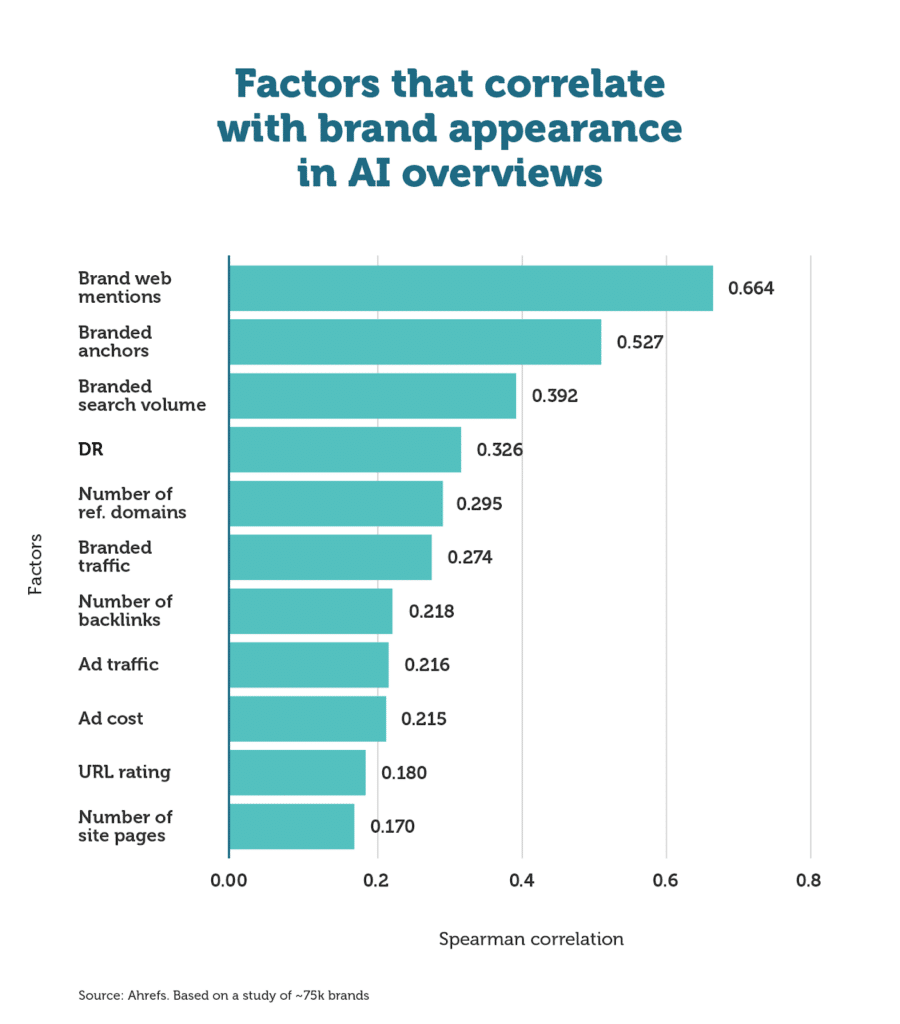
In early 2025, Ahrefs released a brand visibility study which looked at 75,000 brands. It revealed that ‘branded web mentions’ had the strongest correlation with AI overview brand visibility. This presented a much greater spearman correlation than backlinks, and nine other factors including domain rating and branded search volume.
Other AI monitoring tools also launched studies too (like this one from Profound), on the most cited/trusted sources by LLMs - highlighting the need to appear in these top publications to increase chances of being cited.
All of this brought Digital PR back into the spotlight. But not just for links anymore, for brand mentions too. Finally they were being given the attention they deserved.
We’re yet to see what 2026 brings from pop culture to microtrends, but one thing that’s certain - digital PR is fundamental to a strong SEO and GEO strategy, to help drive visibility and ultimately business performance.
We’re still seeing many of the same core tactics being used effectively, but now with brand relevance really being at the heart, robust data, unique insight and speed being key;
- The content campaigns that deliver the best results are more complex, with a strong focus on robust, legitimate data sets and methodologies. We need to be creating something that’s helpful or inspiring for the target audience, that journalists couldn’t create on their own.
- Newsjacking is a huge focus with taking an “always on” approach, and landing quick wins - you need to be quick to react though as the news moves fast. Having an internal expert who can help provide unique commentary that adds something to the story is crucial here, and you need to be able to prove they’re real. AI produced experts and quotes aren’t going to provide value, and will be spotted - these are more likely to be detrimental for the brand with some studies even calling them out.
- Planned reactive - getting quotes or data-led stories ready ahead of time - is also a great way to build topical authority and visibility of an expert.
- Interesting brand news/launches can also be an effective way to land relevant, quality coverage - capitalising on something that’s already going on. As long as it is genuinely newsworthy.
- Stunts are becoming less of a focus in the digital PR industry - with relevancy being essential, many of the stunt styles of the past might not drive the same ROI. Equally, budgets are still being more restricted, so digital PRs are less likely to take risks, and opt for tactics which have a greater chance of driving success.
Wrapping it up: why digital PR matters
2016 saw the dawn of digital PR as we know it today, evolving from a combination of traditional PR and SEO link building. But it’s been on a transformative journey over the past decade. Comparing 2016 vs 2026 shows just how far it has come.
From the initial focus on volume of links to support visibility in traditional search spaces, to relevancy of stories being at the core of driving the right types of links. To now in 2026, branded web mentions also having a fundamental role in GEO, supporting visibility in AI search spaces. It’s clear to see that digital PR has continued to evolve to play a key role in driving online performance over the years, including the tactics and how they’re implemented to gain traction with the media.
References:
- Search Engine Journal (2021) - 20+ years of SEO history
- Google Search Central via YouTube (2021) - Google SEO office-hours from February 19, 2021
- Backlinko (2025) - ChatGPT / OpenAI Statistics
- Ahrefs (2025) - AI Overview brand visibility factors study
- Profound (2025) - AI Platform Citation Patterns