

Executive summary
The online landscape is changing rapidly, with AI-powered search, evolving trust signals and a change in consumer behaviours transforming how people find information and make decisions online. The travel industry in particular has been affected by these changes, with consumers increasingly relying on AI tools to research and plan their trips.
This means that travel brands must rethink how they earn visibility online in this increasingly competitive, fast-moving environment. As a result, understanding how to use digital PR effectively has never been more important.
The state of digital PR in the travel industry report brings together insights from senior digital PR professionals, in-house travel marketers and travel journalists to explore how digital PR is used across the travel industry and why it’s set to become even more important in 2026.
Key findings from the report
- There's a rising demand for digital PR from travel brands, which is set to make the space more competitive: 81% of travel marketers believe digital PR will become even more important in the 2-3 years
- Data-led campaigns are still the most popular tactic for earning coverage and links, but are becoming harder to execute: There is now more emphasis on unique and robust data, originality and stronger methodologies. Seasonality is also key with data-led campaigns.
- Reactive PR is becoming increasingly relied upon: Reactive PR and timely expert commentary are key to securing coverage in a fast-paced, competitive travel media landscape.
- Personalised pitching is now essential: Journalists expect pitches tailored to their area of expertise, their audience and the publication.
- The biggest challenge for digital PRs in the travel space is landing coverage: AI is helping to alleviate some of this through inspiring outreach angles and sense-checking emails.
- Digital PRs aim for quality over quantity with coverage: Almost half of travel digital PRs consider a campaign successful if it secures 0-9 pieces of coverage, and relevance of coverage is the most popular reporting metric, used by 90% of digital PRs.
- Digital PR coverage is being tied to wider benefits by only half of travel marketers: These travel marketers are mostly focusing on ranking improvements, increase in traffic to site and search visibility. A minority are tying digital PR coverage to revenue. However, there is a shared agreement that digital PR is highly effective for SEO and GEO.
- The top predictions for travel digital PR in 2026 include:
- A transition from destination hype to value and relevance: Answering real consumer concerns this year, including convenience, affordability, safety and value
- A need to reflect the consumer's desire for more personalised experiences: It will be crucial for digital PRs to fully understand the different target audience segments and create tailored, targeted stories
- Human-led, story-first PR: To stand out in a world of AI-written content
- Hyper-relevance and targeted outreach will be even more important: To land coverage on key, relevant publications
Table of Contents
Introduction: the state of digital PR in the travel industry 2026
Travel brands are operating in a rapidly changing competitive environment, with AI-powered search, zero-click results, and evolving trust signals redefining how brands earn visibility and credibility online. At the same time, the search landscape has evolved the way consumers find their travel related inspiration, plan their trips and make their bookings or purchases.
With these changes already underway, the need to understand digital PR’s impact and evolving role has never been more important to support online business growth.
The state of digital PR in the traveI industry 2026 report brings together insights from experienced digital PR professionals, travel journalists and seasoned in-house marketers working across one of the fastest moving sectors in search marketing. It explores how digital PR is currently delivered across the travel industry, and how those approaches should shift in 2026.
Why digital PR in travel matters now
“Digital PR has come back into the spotlight over the past 18 months or so, thanks to the rise of generative AI. Alongside a solid technical foundation and fantastic content, brands need digital PR to support GEO - strengthening visibility in AIOs and LLMs like ChatGPT and Gemini - as well as still supporting traditional SEO. This is because digital PR helps build brand mentions and links which are used as a measure of trust and topical authority by these systems.”, explains our Head of digital PR, Chloe Osunsami.
This is particularly important for the travel industry because 84% of people globally are planning to use AI when preparing for trips in the future. That said, it does appear to still be the younger generations who are most comfortable with AI. The same YouGov survey found they are using it for a range of travel planning tasks from helping choose destinations, activities and places to stay through to full personalised itineraries.
This highlights that AI is going to be a key part of the buyer’s and search journey moving forward, and therefore where travel brands need to be visible if they want to compete.
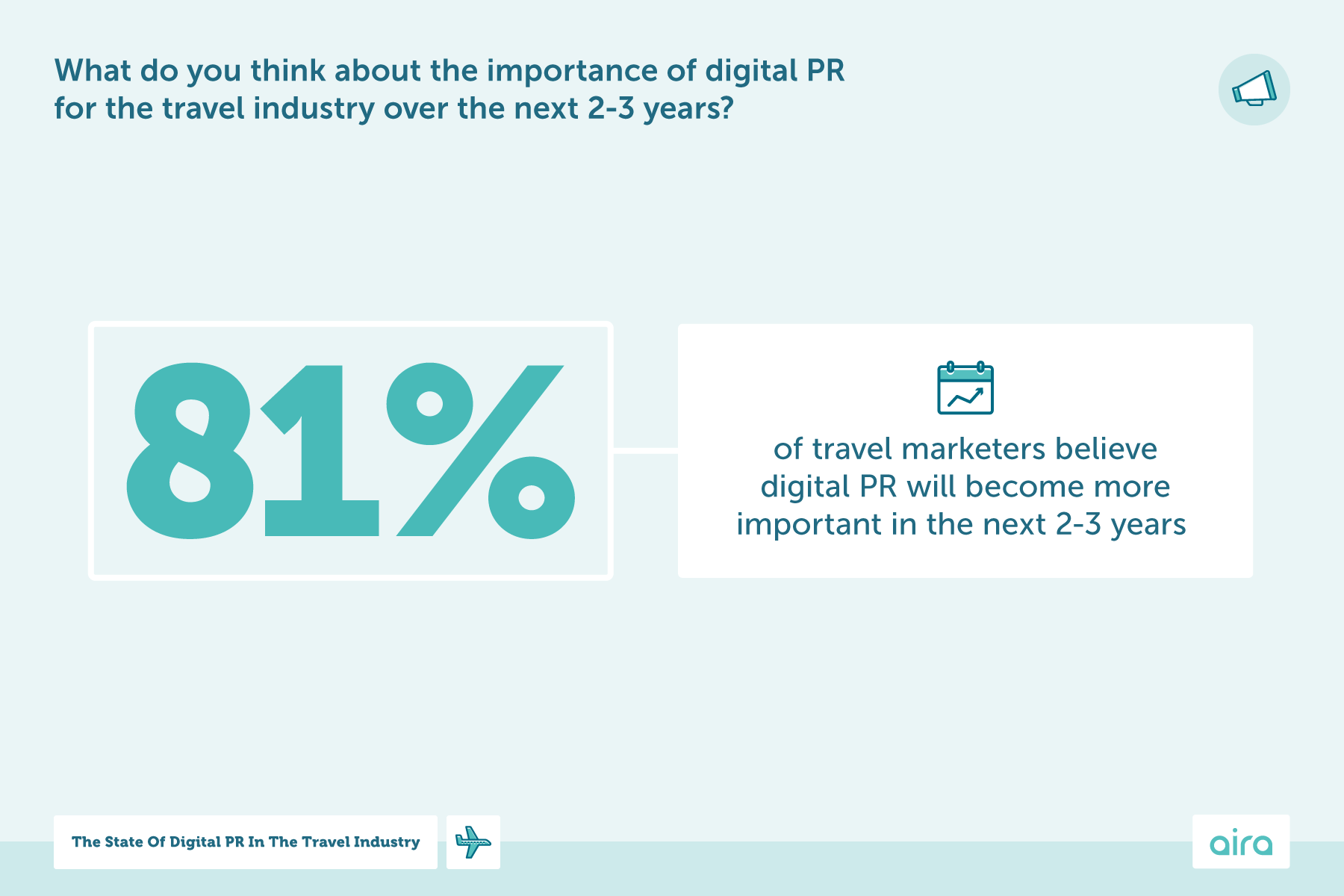
In fact, the vast majority of digital PR professionals expect digital PR to become even more critical for travel brands over the next 2 to 3 years, with 81% of survey respondents believing its importance will grow. Only 14% expect the importance to remain the same, which suggests that even those not predicting growth, still see digital PR as an essential part of marketing. This also demonstrates that there’s minimal concern about the long term relevance of digital PR.
Franco Lucchetti, Head of SEO at Columbus Direct, added:
“One of the main challenges over the past year has been adapting rapidly for visibility in Search. AI has also shaped the way users think, the intent behind the search and as a consequence, their queries, in a much more conversational way. The PR and digital PR world has a huge importance for a brand showing up in Search and Google News and on other websites alike. We have to keep in mind that digital PR is a pillar, for the trust of a website, and for increasing referrals and, in turn, uplifting financial revenue.”
We’re seeing a shared understanding that digital PR is no longer just about links. Brand mentions, trust signals and earned visibility across search and AI platforms are becoming key to long-term growth for travel brands.
Rising demand for digital PR is making the travel space more demanding
Worldwide search interest in digital PR has increased by 34% since 2020, with the UK up 49% and the US up 32% over the same period. Demand for digital PR in the travel sector is just as strong, with 57% of respondents reporting an increase in demand over the past 12 months.
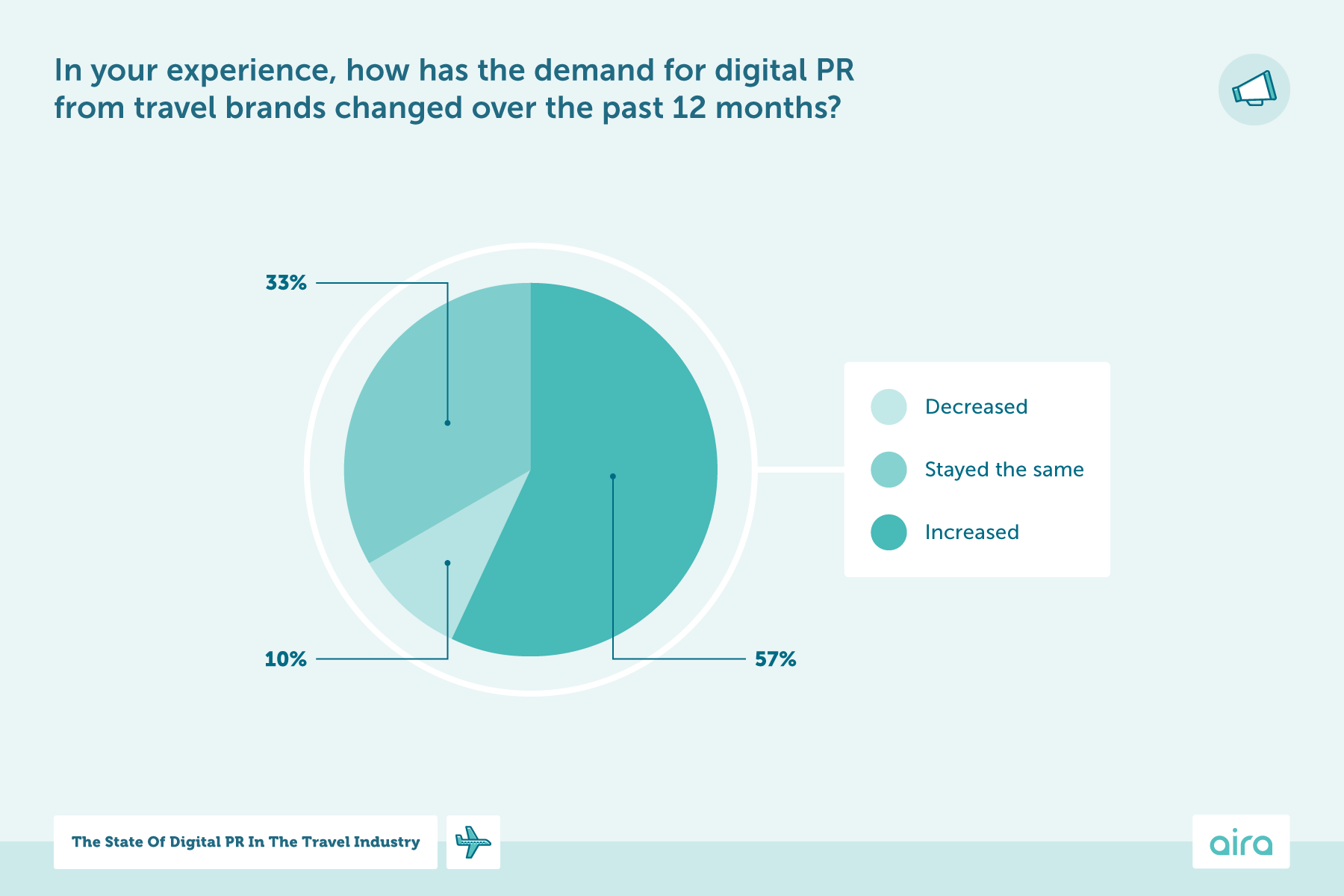
This suggests that travel brands are already becoming increasingly driven by the need for high-quality coverage and increased visibility, due to an intense competitive online landscape.
But what tactics are digital PRs using to drive this high-quality coverage and which are most effective?
Data-led content campaigns still dominate
Data led content campaigns are the most popular tactic for earning coverage and links in the travel sector, with 95% of respondents using them. This highlights the value of credible, data-backed stories when it comes to securing high-quality media coverage.
When asked to select the most effective tactics for earning coverage and links, respondents also prioritised data-led content campaigns, with 67% choosing it as their top choice and a further 33% selecting it as their second choice, further reinforcing its role as the most impactful approach when it comes to gaining coverage.
Other common tactics and techniques include newsjacking/reactive PR and responding to journalist requests (e.g. HARO, Qwoted etc), with 71% of respondents using these approaches to earn coverage and links. This could reflect the travel media’s need for expert insight for relevant stories, such as travel trends. But tighter budgets have also led to a shift in priorities, with many now relying more on reactive and newsjacking tactics, with high-budget data-led campaigns often executed on an ad-hoc basis rather than part of the retainer.
Thought leadership campaigns are used by 62%, while other tactics like link reclamation, resource outreach, and long-form guides are less common.
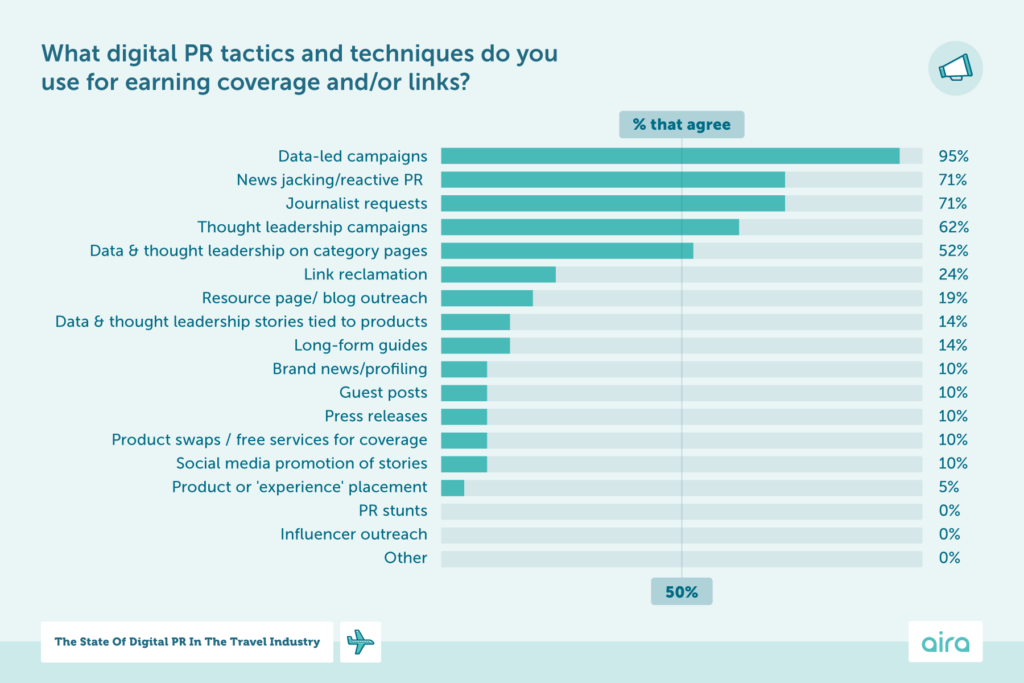
Traditional stunts and influencer outreach were not selected as being used at all. This indicates that data or thought leadership stories, or those that are less risky in delivering a ROI like reactive/newsjacking, are more likely to be chosen by digital PRs today. At the same time brand authority is playing a bigger role, particularly as AI search engines increasingly prioritise trusted sources - so the choice of tactics are likely reflecting this shift too.
One of the most notable themes to emerge is that while data-led content remains the most effective digital PR tactic, it is becoming harder to execute well.
There is now more emphasis on unique and robust data, originality and stronger methodologies. At the same time, the travel sector has become increasingly oversaturated with data-led campaigns, making other tactics often easier to place.
Our Senior Digital PR Specialist, Laura Brothers, adds:
“Data-led campaigns can still be really effective, but only when they genuinely reveal something new. Journalists are looking for originality and credibility. They’re asking tougher questions about where the data comes from and what it actually shows, which makes a robust methodology more important than ever.
As search increasingly favours authoritative, trusted sources, questionable datasets and methodologies will quickly lose traction. The strongest travel campaigns today combine solid data with a clear methodology, and answer one key question: why this matters to the travel audience”
Content led campaigns follow a defined delivery cycle
When it comes to turnaround times for data-led or thought leadership campaigns, 81% of PRs deliver to the client within four weeks, with over half (52%) working to a 3-4 week turnaround. Only a small minority deliver in under a week or over five weeks, suggesting there’s a well-established planning cycle for content-led campaigns across the industry.
These findings suggest that while demand for these types of campaigns continues to grow, PRs that can deliver consistently within a refined delivery cycle will be better positioned to achieve results in an increasingly crowded landscape.
Seasonality continues to influence how travel PR campaigns are planned
Seasonality continues to influence how travel PR campaigns are planned and executed, with clear patterns emerging around both timing and tactics.
PRs tend to align their campaigns with seasonal travel trends and consumer behaviours. For example, wellness and trend-led content in January, family and beach holidays in summer and winter sun and skiing and towards the end of the year. However, for evergreen campaigns, in order to be more timely, seasonality is often reflected in the pitch email and angles used rather than changes to the content itself.
Others note that reactive opportunities spike during the peak travel months with more media requests, so in quieter off-peak seasons, smart planning and looking ahead at emerging trends is important to maintain relevance and consistency in coverage.
Overall these findings highlight that while travel PR is needed throughout the year, it needs to adapt to seasonal trends and reactive opportunities to ensure campaigns remain timely and relevant.
But what techniques are PRs using to ensure their stories gain traction with journalists?
PRs are prioritising tailored, personalised pitches when reaching out to press
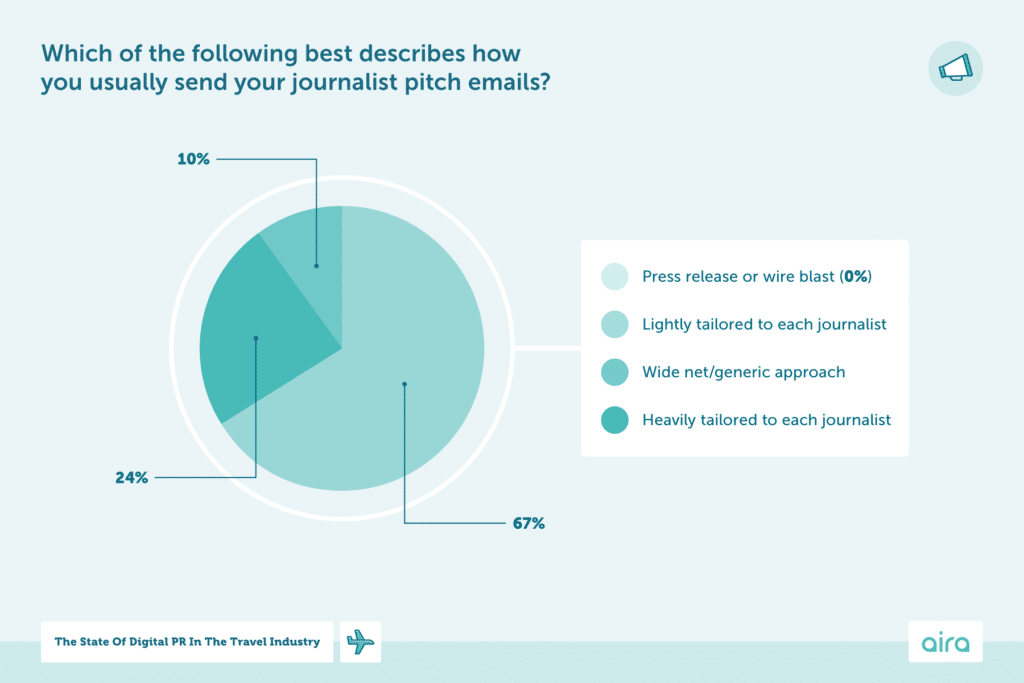
When pitching to journalists, most PR professionals opt for a personalised approach, with 67% of respondents sending lightly tailored pitches, which include the journalist’s name and small details about their publication.
A further 24% go beyond this, with heavily tailored pitches including suggested headlines and angles specific to the journalist’s audience. Only 10% use a wider, generic approach. This highlights a widespread belief that customising pitches can increase the chances of coverage.
These findings are also reinforced by Buzzstream's 'Spray and Pray Study', which analysed over 31 million emails. The study discovered that personalised, more focused outreach dramatically outperforms generic pitching, with higher engagement and links, while ‘spray and pray’ campaigns see lower open rates and significantly fewer links.
Some of the travel journalists we spoke to reinforced the need for more heavily tailored pitches, showing an understanding of the publication and the journalist’s area of expertise;
Gavin Haines, Freelance travel writer and editor highlighted:
“Most of the emails I receive from travel PRs go straight to my trash because they aren’t remotely relevant to my areas of expertise. The ones that don’t go to trash come from PRs who know what I write about and the titles that I write for. It would be great to see more brands sharpening their focus and cultivating more meaningful relationships.”
He also added that “An exclusive, or an inside line” could help - reinforcing the need for PRs to do their homework and suggest an exclusive story which could work for the specific journalist.
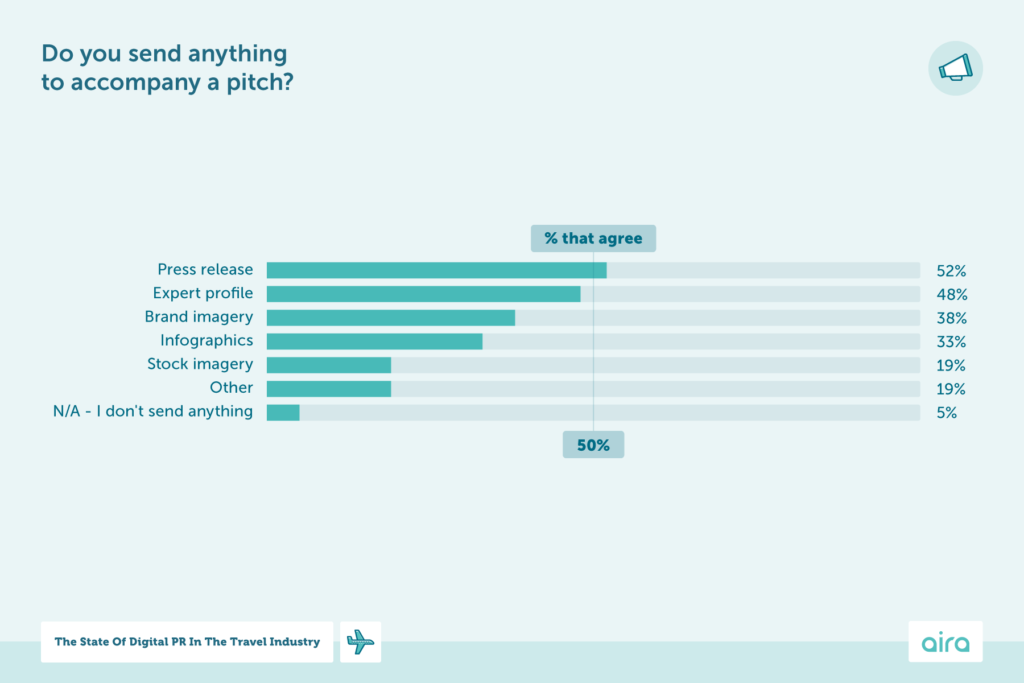
Most PRs also include additional materials alongside their pitches, with approximately half including a press release (52%), and expert profiles (48%).
Visual assets are also common, with 38% including brand imagery, 33% including infographics, and 19% including stock imagery.
Hayley Minn, Deputy Travel Editor at the Daily Mail, added that “Great pictures” can help alongside a strong PR story.
However, despite them being widely shared, journalists are using them less than in the past, with over half of PRs (52%) reporting that journalists use their imagery less than before, and a further 29% note that journalists used to use them but no longer do. This suggests that journalists are increasingly selective over what they actually use, reinforcing the need for relevance, quality, and editorial value.
Sean Walsh, Head of Marketing at Starpeak Limited agreed:
“We’ve found that large portions of the budget go toward design-led collateral that journalists rarely reference or link to. While creative assets can be valuable, they don’t always justify the level of investment allocated to them. A more balanced approach, with costs tied more closely to what actually drives coverage and links, would be welcomed.”
Speed is critical for reactive PR opportunities
When responding to journalist requests or reactive opportunities, speed is a clear priority.
The majority of respondents (71%) typically respond within half a day, with 43% responding within 2 hours or less. This tells us that most PRs recognise the fast paced nature when it comes to reactive news stories and the need for timely responses for the best chances of securing coverage.
Our digital PR lead, Alex Fiske explains:
“We know journalists are busy. We also know that when a breaking news story drops, it’s all hands on deck to provide the best value content to an audience. As PRs, we have access to experts who can supply commentary or data that elevates a story. After all, journalists are looking to make their stories the most credible and helpful too. If we have this information to hand within a few hours, our chances of landing coverage greatly increases. We recommend having a bank of quotes, across a range of topics, that can be tweaked here and there towards the story, to add a unique spin, speeding up response time”.
In addition to supplying expert commentary, speed is also critical for other aspects of the PR-journalist relationship. Speaking to James Wong, Freelance Travel Journalist, he highlighted that “Fast turnaround for fact checking is always appreciated.”
This implies that when an opportunity arises, travel PRs do need to be extremely agile to be able to focus on speed to land the opportunity. But what other blockers and challenges are there when it comes to digital PR in the travel industry?
Approvals remain the biggest blocker to moving faster with digital PR
With a strict delivery cycle when it comes to campaign production, it’s often internal decision making that slows down campaign delivery the most. More than three-quarters of PRs cite approvals from senior stakeholders as the biggest blocker when it comes to moving faster. This is followed by the time needed to source thought leadership input from senior stakeholders (52%), complex data analysis (43%), and coordination with design/development and content teams (38%).
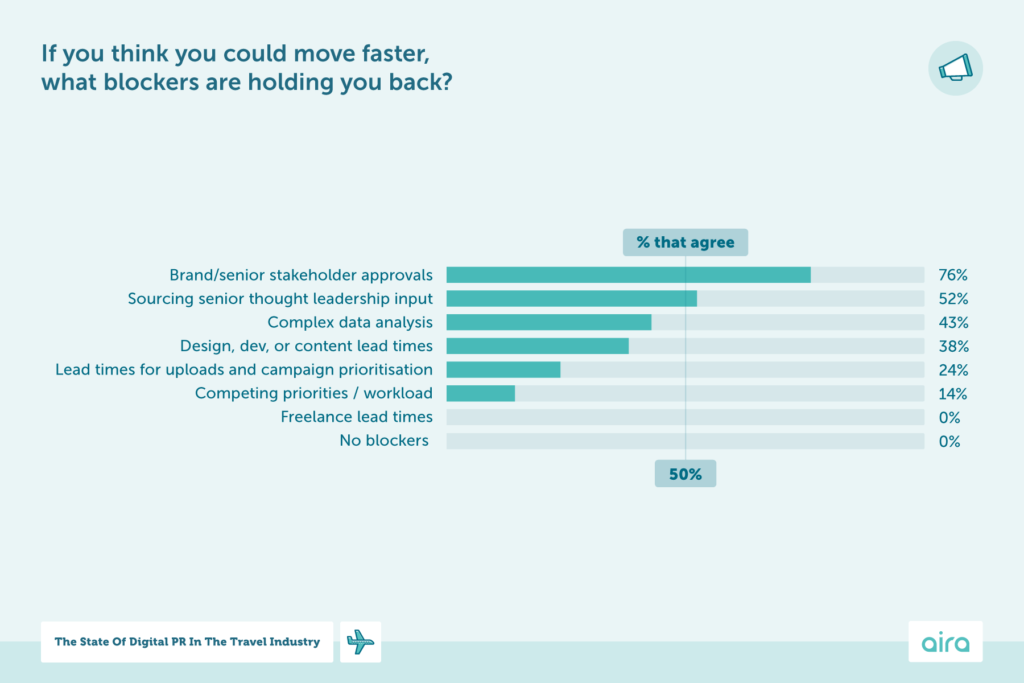
These findings suggest that travel brands that can streamline their approval process earlier in the production phase will ultimately help PRs work more efficiently, respond quickly to media opportunities and stay ahead in an increasingly fast-moving market.
Securing coverage remains the biggest overall challenge
When asked what the most challenging parts of the digital PR process are, securing coverage came out on top, selected by 43% of respondents.
Sean agreed with how unpredictable results have become:
“One of the biggest challenges this year has been inconsistency in digital PR results. A number of campaigns that looked extremely strong on paper unfortunately failed to gain the breakthrough we expected in terms of coverage. Conversely, other campaigns, sometimes the ones we had lower expectations for, ended up landing links at a much faster and more successful rate. It’s been a reminder that even well-researched ideas don’t always align with journalist priorities or timing, and that adaptability is essential.”
This inconsistency is likely due to a number of factors including the way the media landscape has changed, an increasingly crowded space and increasing pressure on journalists who receive a high volume of pitches every day. If a story doesn’t immediately add clear value or align closely with their specific needs, reflecting a topic which is of importance to their target audience at that moment in time too, it is unlikely to be considered. This is only set to get harder, especially if digital PRs don’t do their homework before going into ideation.
This is echoed by journalists themselves. Gavin Haines said:
“Legacy media brands are in many ways returning to their original business models - cultivating loyal readerships and taking them behind paywalls, rather than competing for clicks and diminishing ad revenues. Successful ones will gain a better insight into their readers, develop relationships with those readers and produce richer, more relevant content for them. That’s the idea, anyway. Digital PRs will need to respond to that trend, gaining a better understanding of those publications, the journalists and editors who work on them, and their readers.”
Additionally, finding enough relevant journalists and their contact details was also a significant challenge, selected by 29% of respondents. This highlights that challenges are not only external, but internal too, media database challenges can cause setbacks.
AI is helping Digital PRs alleviate some of their challenges
It’s little surprise that AI is being adopted by travel PRs, but its use remains largely to support tasks. The most common use of AI for digital PRs is insight for ideation, selected by 71% of respondents. This suggests that AI is being used to support, refine and validate ideas rather than generate them - something that used to be a challenge for 20% of PRs and SEOs who did content-led link building.
Another main use of AI among PRs is to sense check data that forms part of an idea, selected by 43% of respondents. A further 38% leverage it to inspire outreach angles and 33% use it to sense-check outreach emails.
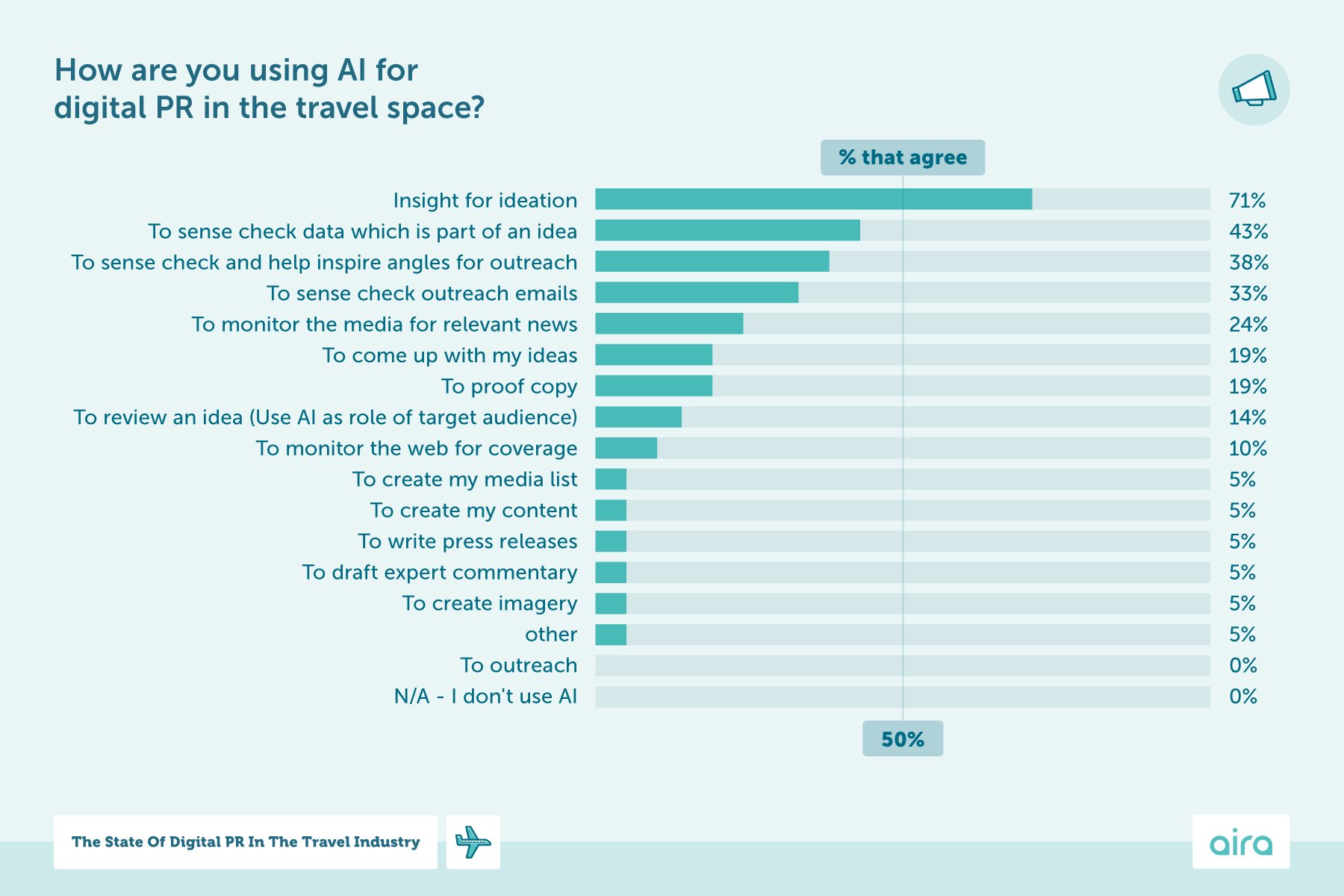
These findings show that rather than replacing PRs, AI is being used to help enhance campaigns and sharpen outreach angles, while creativity and journalist relationships remain firmly in human hands. This shows a clear understanding of where AI adds value in travel digital PR, and where human insight and trust remain critical to success.
Reporting - Coverage expectations tend to prioritise quality over quantity
In the past, digital PR focused on the quantity of links rather than their quality, with the assumption that the more links meant better visibility. Fast forward to today, however, and the emphasis has shifted, where a handful of high-quality relevant pieces of coverage can move the needle far more effectively than dozens of low value, irrelevant links.
This shift is reflected in the survey results. Coverage expectations in travel digital PR clearly prioritise quality over quantity. Almost half of respondents (47%) consider a campaign successful if it secures 0–9 pieces of coverage. Around 24% expect 10–19 pieces of coverage, while some measure success over longer periods rather than per campaign.
Looking back over the past 12 months, PRs show the range of coverage actually secured, with the majority achieving between 10-19 pieces of coverage per campaign (82%).
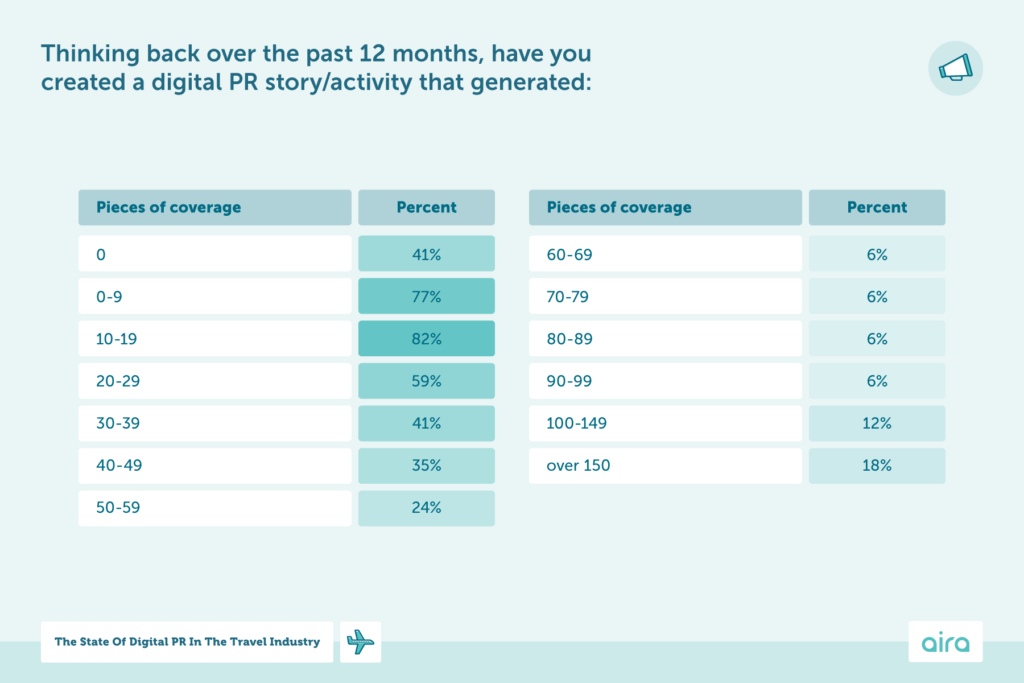
This highlights that while some campaigns can achieve a lot of coverage, most campaigns generate a modest number, and this is deemed a success by those in the industry.
When it comes to setting coverage and link targets, it varies widely among PRs. Only 14% set coverage targets for each activity, whereas 43% set an overall coverage target for the partnership. Almost a quarter (24%) do not set coverage or link targets at all. The low emphasis on link targets suggests that PR teams now prioritise coverage quality over link metrics.
Digital PR lead metrics go beyond just link or coverage counts
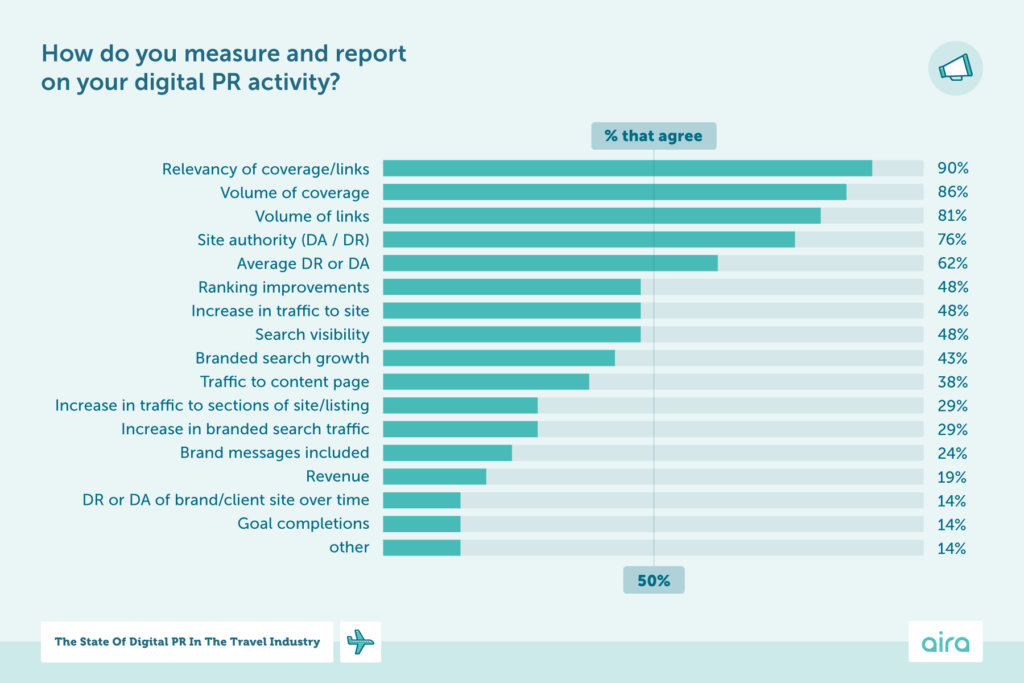
Measuring and reporting on digital PR in the travel industry goes beyond just link counts or coverage volume. The survey highlights a clear set of metrics that agencies and freelancers look upon when assessing the success of a partnership.
The most widely used measure is the relevance of coverage or links, cited by 90% of respondents, again, highlighting that a few high-quality, relevant pieces can be far more effective than a large volume of mentions when it comes to driving meaningful results. This is reported on more than volume of mentions (86%) and volume of links (81%).
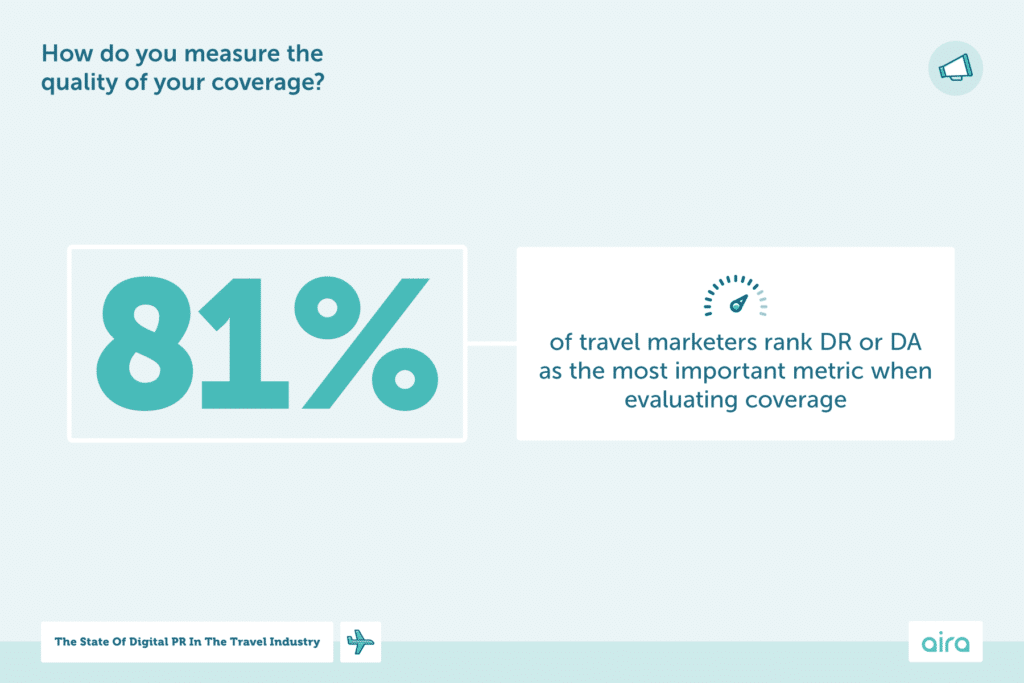
When measuring the quality of coverage, DA or DR continues to be the leading metric, used by 81% of PR professionals.
Internal relevancy scores (38%) and audience insights (24%) are also used quite widely to ensure the coverage is relevant to the campaign and reaches the right audience. Traffic to host sites (19%) and occasional manual grading/tier lists or other methods are applied in select cases.
This highlights that while coverage volume and link volume remain core KPIs, there is a growing emphasis on relevance, impact and audience value.
Lag metrics - Digital PRs are trying to tie activity to wider benefits
Whilst they’re not as commonly used as the coverage lead metrics, we uncovered that roughly half of travel PRs are trying to piece together how their activity is supporting SEO, and helping drive business growth - something that’s always been a challenge in the industry.
48% of digital PRs are looking at and reporting on ranking improvements and search visibility, whilst slightly less monitor increases in branded search volume (43%) and traffic to content pages (38%).
Jolie Hoang, Digital Marketing Manager at Cabin Zero highlighted that “Further understanding effectiveness is key to understanding where we can invest our budget moving forward.”
David Westby, our Principal SEO Consultant adds “Attribution is one of those tricky things in Digital Marketing. What’s even harder is attributing the value of Digital PR coverage to the bottom line.
Lead metrics are clear - and really valuable - but it’s important not to overclaim impact and attempt to give Digital PR full credit for, say, ranking improvements, increased brand visibility etc when there may well be other factors at play.
Digital PR, though, can certainly help with these metrics and using things like Causal Impact we can help show that more concretely.”
Travel digital PR is believed to be highly effective for organic search
On a scale of 1-10, respondents gave it a median score of 8, with the majority (67%) rating its effectiveness 8 or higher. This indicates digital PR is seen as a key part of the SEO and GEO strategy for travel brands, with activity not only to gain coverage, but also improve rankings and traffic to a travel brand’s site.
In terms of timings when it comes to seeing the impact of digital PR on rankings and traffic, most see a result within 1-6 months, with 38% citing 1-3 months and a further 38% citing 3-6 months. This suggests that digital PR is not just a short-term tactic. Campaigns require careful planning, but results are effective within half a year for most brands.
How travel PR has changed in recent years
Over the past 12 months industry experts have witnessed a saturation in travel data campaigns, which has led to a greater demand for solid, unique data, to help brands stand out from the crowd.
However, these data-led campaigns are increasingly being run as ad-hoc projects, especially for those with tighter budgets, where “always on” reactive and thought leadership activity delivers a better ROI than fewer, larger activities.
In fact, compared to 3-5 years ago, travel digital PR experts have highlighted that newsjacking has become significantly more important, especially in peak seasons and with the shift toward expert commentary helping to improve topical authority.
Digital PRs need to ensure they’re providing plenty of value with their thought leadership though, with it being highlighted that simpler thought leadership is now less effective than it used to be.
But what does this mean for where digital PR is headed for the travel industry?
The future of digital PR in travel is set to become even more critical
These findings suggest digital PR is set to become even more critical for travel brands in the future. Travel marketers are now working in an increasingly competitive landscape driven by changes in consumer behaviour, AI-driven search, and an increasing need for trust, relevancy and authority.
Travel brands today need to appear in trusted online environments, with high quality relevant coverage, expert insights and mentions all essential for AI-driven search - and this is where digital PR can support.
Sean agreed:
“Digital PR will continue to sit at the heart of our SEO activity in 2026. High-quality, authoritative coverage remains a core driver of our organic performance.”
But how will digital PR need to evolve in 2026?
The top predictions shaping travel digital PR in 2026
Digital PR will continue to be shaped both by;
- What in-house marketers need to help build visibility for SEO and GEO, and drive business growth online
- What journalists are looking for, how they work and how they’re measured
After all, we operate in the space between these, devising strategies, tactics and stories to land brand coverage with journalists, to ultimately help drive real commercial impact for brands.
Delving into our interviews with senior in-house marketers and travel journalists, we’ve pulled out four top predictions for digital PR in 2026.
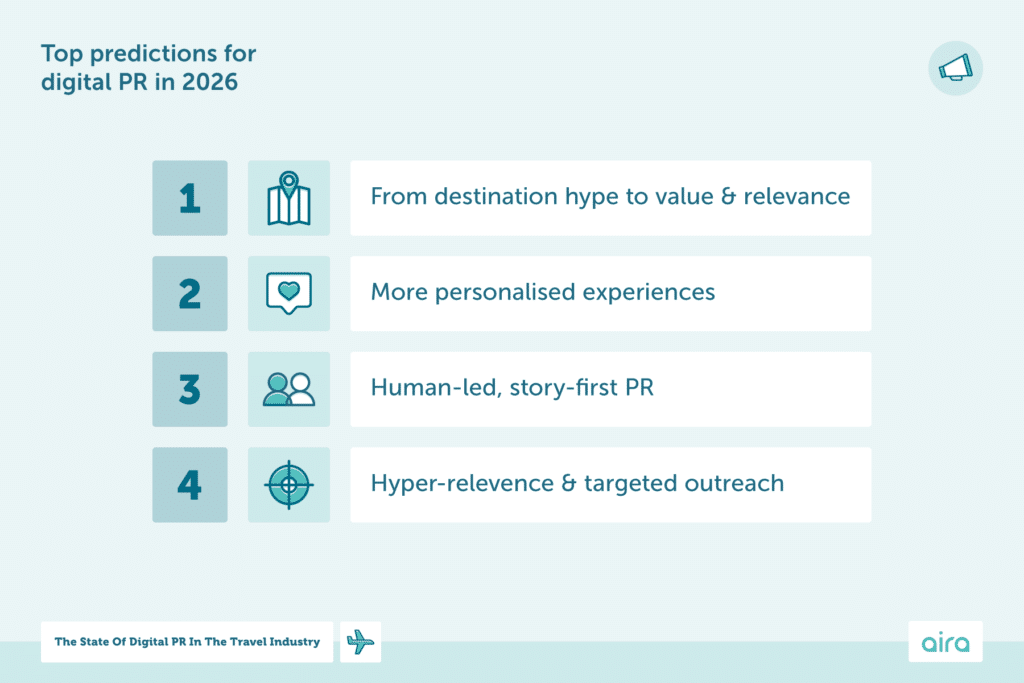
1. A transition from destination hype, to value and relevance
Over the years digital PR has become more focused on the target audience, their needs, wants and desires - and in 2026, this appears set to become even more important.
Both our in-house marketers and travel journalists have highlighted that successful marketing, including digital PR, will lean more on answering real consumer concerns and needs, such as convenience, affordability, safety and other tangible value, rather than just promoting destinations.
Whilst this might not mean the end to all of the fluffier stories like the prettiest destinations using the golden ratio and campaigns based on colour palettes, it might mean these are less likely to be as successful as more value-driven stories - especially as the media is looking to provide value too.
Jolie Hoang highlighted that: “Convenience and saving money are going to be big trends in 2026. We’ve seen these themes continue to grow through what our customers are looking for in our products, and I think these messages will need to shine through all marketing too.” Whilst from the media perspective, Hayley Minn shared that: “Finding more affordable and less crowded alternatives to well-known destinations (destination dupes)... and a focus on value for money rather than luxury” are going to be key trends and editorial focuses this year.
Gavin Haines reinforced this with his predictions noting that: “Rising unemployment and the ongoing squeeze on living costs will narrow the horizons of many British travellers, likely benefitting short-haul and domestic destinations.”
Digital PRs will need to really understand their target audience, their concerns and what’s considered of value to them this year, to be able to shape stories that will resonate. On top of this, they will need a solid grasp on the readership of target publications, to be able to uncover where there is overlap, and which stories are best designed to land in the places that will drive brand impact.
2. Digital PR will need to reflect the consumer’s desire for more personalised experiences
“Travel Marketing will be counting more on personalised experiences and extremely tailor-made itineraries” predicts Franco Lucchetti, who went on to state that travellers are “more aware of what they want”.
Rob Gaige, Head of Global insights at Reddit is quoted within Skyscanner’s 2026 travel trends report highlighting that “rather than selecting the destination and then assembling activities, today’s travellers begin their search with individual passions, hobbies and interests, leading to more meaningful trips.”
Sean Walsh let us in on the insight that “interest in activities such as trail running, cycling holidays, hiking routes, water-sports and general “challenge-based” trips has been climbing for the past few years, and we only anticipate that demand accelerating into 2026. UK travellers are increasingly looking for trips with purpose, physical engagement and unique, story-worthy experiences rather than passive holidays.”
Within skyscanner’s 2026 trends report Rob Gaige further highlighted that there is “more time being spent on researching specific activities.”
Alongside hobbies and interests, Gavin Haines highlighted several economic and real-world factors that could influence personal travel and holiday decisions this year, such as “the reluctant return to the office five days a week for many workers … set to re-harden the boundaries between work and play, signalling an end perhaps to the longer hybrid holidays many enjoyed before.” .
Together these insights show how crucial it’s going to be for digital PRs to fully understand not just the overall target audience, but different segments of the audience and their interests. Brands with multiple target personas will need to have activity designed for each one to be able to target them effectively through tying into these key areas of interest and the economic and real-world factors which might influence their holiday or travel plans. It’s likely digital PRs will no longer be able to plan all activity to cover as many target personas as possible, as it just won’t be as effective in landing coverage or driving business impact.
Looking ahead, Virtual Reality (VR) and Artificial Intelligence (AI) will offer an opportunity to bring these personalised experiences to life. Franco Lucchetti highlighted that while VR may not be mainstream yet, AI can already help travellers make the most of their time by offering “best-of” experiences before they travel.
3. Human-led, story-first PR will stand out in a world of AI-written content
The word of the year in 2025 was “AI slop” - we think that sums up where a lot of content production has been heading. In this new era, real human stories are becoming more valuable in setting content apart as these are the elements AI isn't mimicking, and a key way readers can tell human-written narratives apart.
Across the travel journalists and in-house marketers we interviewed, there was a strong agreement that authentic, experience-led storytelling will be the differentiator in 2026.
Franco Lucchetti highlighted that “authentic stories are pure marketing!” and added that “user-generated content” and “deeply personalised narratives” will be key trends this year.
Journalists strongly echo this. James Wong notes a clear editorial move “As we battle with AI, I’ve already noticed a shift from generic guides to much more personal travel stories. The kind of stories that cannot be imitated by an algorithm.”
Gavin Haines added that he foresees “a greater embrace of rich, human-led travel narratives from more discerning outlets” while Hayley Minn highlighted that these stories are “more interesting to read about, as they’re more relatable so are great for the paper, and do well online.”
As our survey results suggest, AI might support digital PRs in areas such as ideation and outreach strategies/approaches, but digital PR stories need a clearly visible human touch.
The key way to achieve this is by including first-hand human experiences, i.e. using case studies and real people to surface untold angles, personal insights and give behind-the-scenes access. This can be applied within ideation and the concepts taken into production, or through thought leadership. This not only helps set content apart for a reader and the media, but it also strengthens E-E-A-T for the content itself.
We expect this to become more prominent within digital PR stories. These human narratives are likely to be much more effective in driving coverage and therefore topical authority.
4. Hyper-relevance and targeted outreach will be even more important
Our survey results show that the majority of digital PRs already tailor outreach, and a quarter heavily tailor pitches with suggested headlines. However, insights from the travel journalists and editors we spoke to lean towards preferring a heavily tailored approach, signalling the end of “spray and pray” - especially for those who want to land coverage in key travel titles.
Hayley Minn, Gavin Haines and James Wong all emphasised the importance of digital PRs understanding the writers they’re pitching to, their audience, editorial styles and topics of interest or expertise.
Hayley Minn added that digital PRs should “ Think about headline first, and what actually draws a reader to click … Trying your hand at writing a headline in the Mail’s style at the top of a press release/when offering a press trip always makes me more likely to run the story, as it means I don’t need to find the story within the press release.”
Travel writers and editors have KPIs too, ranging from page views and engagement to how their content helps drive subscriptions. When they read digital PR pitches, they likely have these in mind to determine if a story is worth being one of the 2-20 stories they, or their team, plan to write that day. This is key to keep in mind, as it helps keep focus on what’s going to drive those results for the publication, the writer, and how digital PRs can help.
Gavin Haines added “I don’t have many relationships with travel PRs but the ones I do have work brilliantly because they understand my approach, the outlets I write for and how they can work within that.”
When asked about relationships for expert commentary both James Wong and Gavin Haines highlighted that they usually source their own experts through their connections to ensure they have unique insight for their stories. This demonstrates how important it is to build relationships with key writers and editors, to increase the chances of being called upon for expert commentary.
Digital PRs doing their research on the publication and specific writer is only set to get more important. As Gavin Haines highlighted, legacy media brands are returning to their original business models, strengthening their relationships with their readers, and digital PRs will need to respond to this trend if they hope to land coverage in these places.
Conclusion what this means for travel brands in 2026
As AI-powered search and zero-click results become the new way travellers plan their trips, travel brands can’t rely on rankings alone. Visibility is now also driven by authority, brand mentions and being cited by trusted sources - which is exactly where Digital PR comes in.
While links do still play a part, brand mentions, expert commentary and credible insights are becoming increasingly important trust signals for both search engines and AI-driven platforms. Travel brands that ignore this risk not being seen where their audience is actually searching.
Reactive PR and expert commentary are proving crucial ways for brands to gain traction - but only if they can move quickly. Data-led campaigns are still implemented by most travel digital PRs, even if on a more adhoc basis. However, long approval processes and slow sign-offs are holding a lot of brands back. Those that can streamline decision-making and who have spokespeople on-hand will be much better placed to take advantage of opportunities as they happen.
Human stories are also becoming more valuable than ever. In a landscape increasingly crowded with AI-generated content, journalists and readers are searching for real experiences and stories. Travel brands that can bring human insight and expertise together, will stand out in ways where AI can’t.
We’re also seeing a shift around the volume of coverage needed. A handful of high-quality, relevant pieces of coverage that actually address the traveller's needs can far outweigh lots of low-value mentions. For brands, this means focusing less on how many pieces of coverage they earn and more on where the coverage appears.
Overall, digital PR in travel for 2026 is about setting brands apart from AI written content, creating stories which demonstrate value to the consumer, and resonate with key audience interests. It’s also about doing the research to heavily tailor journalist pitches and maximise chances of exposure. . The brands that get this right will earn visibility where it matters most - in front of the traveller.
We’ve specialised in travel digital PR since 2016, helping brands build long-term organic growth in a constantly evolving search landscape. With over a decade of experience, we know what it takes to secure high-quality coverage, build trust and drive real impact for travel brands. Take a look at our travel digital PR case studies to see our work in action and the results we’ve achieved.
Want to see how we can help support your travel brand with digital PR in 2026 and beyond? Visit our travel digital PR service page to discover what we can do.
Methodology
We conducted a survey of 21 senior digital PR practitioners, with long-term, hands-on experience across digital PR and SEO in the travel industry. Respondents represented a mix of agencies and freelancers supporting travel brands including booking platforms, accommodation providers, holiday companies and transport providers.
Alongside this, we conducted in-depth qualitative interviews with in-house travel marketers and travel journalists and editors to provide insight into both the brand perspective and what the media is predicting and looking for in 2026.
The survey and interviews took place between November 2025 and January 2026.