



Your pitch might never be read. Not because the journalist ignored it - which does happen, especially if your subject line doesn't show relevance to the topics they cover or areas of interest at that moment in time. But because an AI summarised it first, got it wrong, and the journalist moved on without ever seeing what you actually wrote.
AI is already embedded in how journalists on the receiving end of your pitches work. And in our analysis of 628 emails, up to a third of AI summaries misrepresented the original - the data, the information, or the expert commentary inside it.
We collaborated with digital PR tool BuzzStream to look at how AI inside the three largest email providers - Google, Apple and Microsoft - is summarising pitch emails: which elements of the original email carry the most weight, and what that means for how PRs should structure pitches from here.
Key findings from 628 emails
- Up to 1 in 3 AI summaries misrepresents the pitch. Apple highest at 33%, Microsoft 30%, Google most accurate at 11%.
- Summary length varies 5× across platforms. Google compresses to 29 words; Microsoft Copilot expands to 157 and pulls in outside Bing context you never sent.
- Bullet points are the single most influential format, appearing in 64-92% of summaries across all three platforms.
- The first half of your email is the only half that matters. 65-87% of summary content comes from there.
Why AI email summaries matter now
According to Gallop's Workplace Panel in Q4 2025, 26% of US employees use AI a few times a week and 12% use it daily; in the UK, the 2026 GOV.UK Survey on AI Skills highlighted that 21% say AI has increased their productivity at work.
Muck Rack's 'The State of Journalism 2026' report uncovered that among journalists specifically, AI adoption has climbed to 82%, with ChatGPT and Gemini leading the way. So AI is already embedded in the daily workflow of the people you're pitching to.
The same report found that 29% of journalists now receive 6-10 PR pitches on a normal work day, up from 25% the year before - and 14% of journalists record getting more than 20 pitches a day! At the same time, understaffing and time constraints worry 20% of the profession, and disinformation and misinformation was cited as one of the biggest issues of concern to 32% of journalists.
So journalists are inbox-heavy, concerned about misinformation, and already finding ways to increase productivity and efficiency - meaning the question is not whether AI is summarising your pitches, but how, and if those summaries are accurate or being classed as misinformation.
What 628 emails (and their AI summaries) reveal
We analysed emails for 13 different campaigns. Each campaign had 4-11 email templates, with each template isolating individual variables like subject lines, formatting, data placement and links. Every email was sent to two addresses per email platform (Google, Apple and Microsoft), and summaries were recorded and analysed to determine which variables had influence over the summary output.
Three findings stood out: platforms produce wildly different summaries, roughly one in three summaries misrepresents the original, and bullet points were most likely to influence what AI surfaces. Each has practical consequences for how a pitch should be written moving forward.
AI email summaries are dramatically different across platforms
The platforms don't just summarise differently, they produce fundamentally different outputs. So which email provider the journalist uses could impact how they receive your email.
| 29 words | |
| Apple | 50 words |
| Microsoft | 157 words |
Google (Gmail's Gemini) produces the shortest AI email summaries at just 29 words on average - meaning your entire pitch is being compressed into roughly two sentences. There's almost no margin for error when the summary is that compressed.
Apple sits in the middle at around 50 words. Whereas Microsoft (Copilot) generates the longest AI email summaries at an average of 157 words, giving it room to capture more detail but also more room to deviate from the original.
Microsoft Copilot was the only tool we saw pulling in information that wasn't in the email itself. Its built-in web-search capability grounds responses in Bing results - which can include the campaign you're pitching - unless an admin switches it off at organisation or group level. In practice, that means Copilot will sometimes summarise your pitch using context you never sent.
PRs and marketers need to think about the possibility of having emails both being summarised in brief, or with a longer summary.
One in three emails is misrepresented
AI summaries misrepresented information in up to one in three emails.
| 11% | |
| Microsoft | 30% |
| Apple | 33% |
Apple had the highest error rate at 33%. Microsoft followed at 30%. Google was the most accurate at 11% of emails being misrepresented by the summaries - but even that means one in nine summaries contains something that wasn't quite what the email said.
The types of errors matter too. We saw:
- Overgeneralisation - some summaries make the email sound like it's just focused on one area, when it covers a broader range of data and hooks.
- Data misinterpretation - one example being confusion between similar data sets, where the AI conflated two distinct statistics into one misleading statement.
- Misrepresentation of expert commentary - one example being that an expert recommended "keeping your vehicle as charged as possible - around 40-80% is ideal", but the email summary surfaced "charging to 40-80%", which reads as only charging the battery by that amount. Very different and not something we'd want journalists to think our 'expert' would recommend.
- Misinterpretation of context - for example, the AI read the heading row of a city-ranking table and reported the top-ranked city as 'best for everything', when the table actually ranked separate categories (cost, commute, schools) independently.
These aren't dramatic fabrications, but they're subtle distortions, the kind that could make a journalist question your expert or if you're giving misinformation - and you'd never know it happened.
Bullet points are doing more work than ever
| Apple | 64% |
|---|---|
| 65% | |
| Microsoft | 92% |
Of every formatting trick we tested bullet points were the most likely to influence the AI email summary output, being included in at least 64% of summaries across every platform:
- Microsoft Copilot - the heaviest influence at 92% inclusion.
- Apple Intelligence - pulled bulleted content 64% of the time.
- Google Gemini - 65% inclusion rate. Notably, it's the only platform that appears to have a preference over bullet point position, most often pulling from the first bullet.
Bullet points have always been useful for pitch emails - they break up a wall of text and let a busy journalist scan the key facts of your story quickly. But if journalists are starting to lean on AI email summaries to speed up reviewing their inbox, those bullets are doing more than just helping a human skim, they're actively shaping what AI flags as the important points of your pitch.
If AI is doing the first read of your email for a journalist, your bullet points are doing the first selling for you.
Platform by platform: how Google, Apple and Microsoft handle your pitch
The table below shows the average summary length, and the percentage of AI summaries, per platform, that featured specific variables from the pitch emails.
| Metric | Apple | Microsoft | |
|---|---|---|---|
| Avg. summary length (words) | 29 | 50 | 157 |
| Content in summary taken from the first half | 87% | 82% | 65% |
| Bullet point included | 65% | 64% | 92% |
| Bold text included | 48% | 26% | 25% |
| Table information included | 41% | 19% | 49% |
| Personalised intro included | 11% | 0% | 61% |
| Mention links included | 1% | 0% | 71% |
| Misrepresentation rate | 11% | 33% | 30% |
Four secondary findings round out the picture:
- AI email summarisation pulls disproportionately from the first half of the message. This isn't surprising if you think about how these models are designed to work - but it has real implications for anyone crafting pitches.
- Subject lines play a role too. Keywords like "new," "data," and the expert's position are pulled into summaries more frequently when used in subject lines vs only in the body of the email, with Microsoft Copilot email summary generation showing the strongest subject-line influence.
- Bold text has a weaker effect than you might expect, influencing only 25-48% of summaries depending on the platform.
- Tables have minimal impact - perhaps because they're usually further down the email.
- Graphics or attachments are essentially invisible to all three systems.
What this means for how PRs should write pitches
This isn't about gaming an algorithm, there's no set formula or way around AI email summaries. It's about understanding a new layer between your email and the person you're trying to reach, and writing with that layer in mind to increase the chances of the right things being surfaced and emails not being misinterpreted.
-
1Front-load your most important informationAI pulls 82-87% of summary content from the first half of your email. Put your best material first.
-
2Use bullet points deliberatelyBullet points appear in 64-92% of AI summaries. Lead with your strongest data point in the first bullet.
-
3Keep data clear and contextualisedAI misrepresents 1 in 3 emails. Keep every figure standalone, with context in the same line.
-
4Craft your subject line carefullyKeywords like 'new', 'data' and the expert's position pull through more often when in the subject line.
-
5Don't rely on tables, graphics or links for key informationTables are cited in <50% of summaries and graphics don't appear to have an influence. Keep key info in the body of your email.
1. Front-load your most important information
It's always been crucial for PRs to get to the point right at the top of an email, so the journalist can easily see who, what and why - including why it's relevant right now. It's now even more essential to have anything you want surfaced in summaries at the top.
If your strongest data point, your most relevant hook, or your expert credentials sit in the second half of the email, there's a chance the AI email summary will never surface them.
2. Use bullet points deliberately
Bullet points have always been useful for pitch emails - they let a busy journalist scan the key facts quickly - now, they're actively shaping what AI flags as the important points of your pitch.
The findings make two things crucial:
- Lead with your strongest data point or information in the first bullet point.
- Keep bullet points as simple as possible. Make sure each bullet is phrased really clearly with context, and can be understood on its own, so it can't be confused or misinterpreted by AI.
This might sound like obvious advice, but complex bullet points can lead to the misinterpretation we're trying to avoid.
3. Keep data clear and contextualised
With AI misrepresenting data in roughly one in three emails, the way you present statistics matters more than it used to. Some key things to keep in mind:
- Include the context immediately alongside the figure, so every data point can be understood on its own - like a standalone point.
- Avoid layering multiple comparisons, or if you need them ensure they have clarified in the most simple way possible.
4. Craft your subject lines carefully and include key words
Whilst subject lines influenced under half of AI email summaries, key words like "new" and "data" appeared significantly more often in email summaries when it was included in the subject line than when it was just in the body of the email.
Including key words like these, that simply and clearly demonstrate what you're offering can help ensure the journalist receives that in their summary. Plus, remember the subject line is what gets the email opened in the first place.
If you're pitching expert commentary, we'd recommend using their position in the subject line too, to help sell their expertise. This also appeared more often in email summaries when used in subject lines than when solely used in the body of the email.
5. Don't rely on tables, graphics, or links to carry crucial information
Information and data from tables is included in fewer than half of AI email summaries, which could be because tables often sit slightly lower down emails too. They're not completely redundant though, and it appears the top 1-3 entries in a table are most favoured. But don't hide crucial information you want to highlight to the journalist in the first instance in tables, or it might get left out.
In addition, information from graphics and attachments don't appear to be included in summaries at all, and only Microsoft Copilot mentions links - even then, full URLs are cited just 3% of the time. This further emphasises the importance of including key selling points at the top of the email, yet still including these elements for those journalists who want to explore the story further.
In summary, PRs are now writing for three readers, not one
PR professionals have always written for two audiences - the journalist and their readers. Now there's a third, the AI that sits between the send button and the journalist's attention. And unlike a human reader, it doesn't ask for clarification when something is ambiguous. It just summarises - sometimes accurately, sometimes not - and moves on.
The good news is that this is a solvable problem. Our research gives us clear signals about what these systems prioritise and where they fail.
The shift isn't dramatic, it's structural. Front-load your strongest material, format for clarity rather than visual appeal, and accept that roughly a third of the time an AI is going to get something wrong - so write in a way that minimises the damage when it does.
Ultimately, these are the same techniques that make for good PR pitching anyway - being clear, being relevant, putting the strongest material first. The AI layer just raises the stakes on getting it right.
If you want to dig deeper into how Aira's digital PR team approaches outreach strategy, or if this research has raised questions about your own pitch structure, we're always happy to talk through it.
Methodology
We tested 13 digital PR campaigns, creating 4-11 outreach email templates per campaign. Each template varied one element at a time to isolate its effect on email summaries. Variables tested included subject lines, bold key points, bullet points, tables, tailored introductions, graphics, press releases, and links to full campaign content, expert LinkedIn profiles, or About Us pages.
Every template was sent to two email addresses across each of the three major providers (Google, Apple, and Microsoft), allowing us to also assess whether the same provider generated different summaries for identical emails. All summaries were recorded on receipt.
Summaries were analysed against a set of research questions to identify the key factors shaping them and to assess whether they accurately represented the original emails. Claude AI supported part of the analysis, but methodology and raw outputs were manually reviewed to validate conclusions. Manual review also covered most research questions directly - including the impact of bold points, bullets, and tables, and any cases of misrepresentation.
Data was collected and analysed across March and April 2026. The complete collaborative study, with all data, can be found at https://www.buzzstream.com/blog/ai-generated-email-summary/.
Put simply, the buyer’s journey is the active process someone goes through to become aware of a problem, weigh up the ways to solve it, and decide on a purchase. But there’s a lot more to it than that...
Here we’ll take a look at what exactly the buyer’s journey is, its different stages, why it’s important and how to create one for your audience. We’ll also look at how to create content that aligns with the buyer’s journey and how this can really benefit your marketing efforts.
Buyer’s journey definition
Let’s start with a clear definition. Here is how Aira’s Head of Performance frames the buyer’s journey:
Within the buyer’s journey a business needs to consider not just how people research and purchase, but also the symptoms and problems that form the beginning of their journey, and how they move along the different stages of their journey.
Buyer’s journey stages
The three stages of the buyer’s journey are Awareness, Consideration and Decision.


These three stages are a model, not a rule. Real buyers rarely move through them in a tidy straight line - they loop back, skip ahead and revisit stages as they learn. Some frameworks also stretch the journey into five stages by adding the purchase and post-purchase steps; there is more on that in the FAQs below.
Buyer’s journey vs customer journey
The two terms are often used interchangeably, but they are not the same thing. The buyer’s journey covers the pre-purchase path - awareness, consideration and decision - and ends at the sale. The customer journey is wider: it picks up where the buyer’s journey finishes and follows the whole relationship after the sale, through onboarding, support, renewal and advocacy.
In short, the buyer’s journey is the first chapter of the customer journey. Map the buyer’s journey to win the sale; map the customer journey to keep and grow the account.
Why is the buyer’s journey important?
The buyer’s journey gives value to customers
A major problem with traditional marketing is that it wasn’t designed to help people. Traditional advertising uses tactics that shout for attention and tell people what they need. It doesn’t provide value by educating people, reflecting the way modern buyers search for information online.
The buyer’s journey is a vital aspect of this evolved form of marketing because it enables businesses to help their customers, by providing informative content to enable them to understand their problem and their options for solving it.
It will help you sell your products/services
If you can create content that helps your audience at each stage of their buyer’s journey, you will have a good chance of getting them to engage with your website, and subsequently become a lead. You then have the opportunity to nurture that lead with more useful content and personalised pre-sales support, until they hopefully become a customer. And let’s face it, that’s what we all want, right?
Your ideal customer wants the right content at the right time (which is on demand, whenever they need it) and they want it in the format they prefer. By creating content aligned with the buyer’s journey, you should always be able to provide them with helpful, relevant content that will be genuinely useful and aid them in moving along their buyer’s journey.
The proof is in the statistics
The numbers underline why the buyer’s journey, and content mapped to it, matters:
Format matters as much as message: buyers lean on different content types as they move along - preferring webinars and guides early on, and case studies and product demos as they near purchase.
You need strong content mapped to each stage of the buyer’s journey, and it needs to be visible in search results, as well as answers from AI assistants, for the questions and keywords your audience actually uses.
This is where keyword research and mapping comes in. Aira’s Dan Brooks wrote a guide to labelling keywords by buyer’s journey stage. By tagging keywords to the awareness, consideration and decision stages, you can build content that both users and search engines respond to. Done well, your audience can discover genuinely helpful content from you, wherever they are in their journey.
Putting together keyword research, keyword mapping, content design, and content promotion takes strategic thinking and dedicated resource, which is often where external consultants can help. Whether you work with a digital marketing agency or utilise your in-house team, considering the buyer's joruney in your content strategy can reap rewards if done well.
Buyer’s journey content
So telling you to create great content might be quite obvious, and a little unhelpful. What should your content actually look like? What format should it take? How exactly should it align to the Awareness, Consideration and Decision phases of the buyer’s journey?
The actual content you create, and the formats you choose, will differ depending on your buyer personas (the semi-fictional representations of your ideal customers). Some personas will prefer blog posts, some will prefer video content, some perhaps original data, charts and templates. The focus of your content will differ too, depending on which of your personas you are targeting.
Let’s briefly look at a couple of Aira’s own buyer personas to explain why content needs to differ:
- Marketing Marvin is a marketing manager, interested in traffic growth and lead generation. Marvin gets most of his information from reading industry blogs and news.
- Sales Sally is a sales manager and is much more interested in improving sales processes and customer acquisition. Sally reads industry blogs, but also watches a lot of video content.
It’s easy to see that, despite both being potential customers, these two personas want different content to satisfy their needs and help solve their problems.
It’s essential to develop buyer personas, otherwise you won’t be able to create targeted content in an appropriate format, and you won’t be able to map accurate buyer’s journeys for your audience.
With personas, you can create content that is relevant and useful, and by mapping a buyer’s journey for each persona, you can plan content to engage each customer type at each stage of their journey.
How to map content to a buyer’s journey
Now you know a bit about the benefits of the buyer’s journey, it’s worth looking at how to apply it to your content strategy. If you want to do buyer’s journey mapping for your own business, here’s how to get started:
Create buyer personas
We’ve already talked about the importance of buyer personas, but having them in place really makes defining your audience’s buyer’s journey so much easier. By understanding their problems, needs, motivations, and goals, you can create helpful content to support them.
If you’d like to learn more about this stage of the process take a look at our comprehensive guide to buyer personas.
Buyer’s journey examples
Let’s take a look at some buyer’s journey examples to further illustrate the process, and show how this can lead to content that is engaging for your audience.
Here’s a buyer’s journey example for our persona Marketing Marvin. It shows his thought process and the kind of on-site and downloadable content we might create to attract and engage him:
| Awareness stage | Consideration stage | Decision stage | |
| Thought process | My website traffic has dropped suddenly | I need to increase website traffic | An SEO audit would help me to develop an effective strategy |
| On-site content | 11 Reasons Why You’ve Seen a Sudden Drop in Website Traffic | 7 Ways to Drive Website Traffic with Limited Time | How Much Should an SEO Audit Cost? |
| Content offer | SEO Traffic Drop Diagnosis (checklist) | The Ultimate Guide to Growing Website Traffic (ebook) | Free 1-hour SEO consultation |
Here’s an example we created for On the Go Tours, who organise group tours and bespoke holidays:
| Awareness stage | Consideration stage | Decision stage | |
| Thought process | I’m too stressed | A holiday will help relieve my stress | Which adventure holiday should I choose? |
| On-site content | 5 Ways to Prevent Stress | The World’s Best Stress-relieving Destinations | The 10 Best Adventure Holidays |
| Content offer | The Complete Guide to Dealing with Stress (eBook) | Hotel or Adventure Breaks? (infographic) | How to Choose Your Perfect Holiday (quiz) |
As you can see, the process is pretty logical, and it’s not too difficult to plan content to address the problems your audience is facing as they move through their buyer’s journey.
Certain types of search terms and phrases often appear as buyers reach different stages, which can help you plan the kind of content that would be most helpful, and therefore engaging, for them. As you can see from the table below, awareness stage terms often include things like ‘troubleshoot’, ‘resolve’, and ‘improve’. At the consideration stage you’re likely to see phrases including ‘solution’, ‘service’, and ‘tool’; and at the decision stage terms like ‘compare’ and ‘review’ are common.
Evaluating search terms and their motivations can be helpful when planning content throughout the buyer’s journey, but they are certainly not definitive and should be used as guidelines rather than rules.
| Awareness | Consideration | Decision |
|---|---|---|
| Problem / Opportunity Terms | Solution Terms | Comparison Terms |
| Troubleshoot | Solution | Compare |
| How to | Provider | Versus |
| Resolve | Service | Vs. |
| Risks | Supplier | Comparison |
| Upgrade | Tool | Pros and Cons |
| Improve | Device | Review |
| Optimise | Software | Test |
 Terms relevant in each buyer’s journey stage
Source: HubSpot
Just remember that your aim is to create content that is as helpful as possible for your personas at every stage. If you can provide real value to your target audience, your content is likely to bring more traffic to your website and lead to more purchases.
Buyer’s journey FAQs
What is the buyer’s journey?
The buyer’s journey is the active process a person goes through to become aware of a problem, evaluate the ways to solve it, and decide on a purchase. It describes the route to a sale from the buyer’s point of view rather than the seller’s.
What are the steps in the buyer’s journey?
The core model has three steps: Awareness (the buyer realises they have a problem), Consideration (they research the approaches that could solve it) and Decision (they compare providers and choose one). In practice, buyers move back and forth between these steps rather than through them in a straight line.
What are the five stages of the buyer’s journey?
There is no single fixed five-stage model. Some marketers extend the three core stages by adding a purchase step and a post-purchase step, such as retention or loyalty. Others use the classic consumer decision-making process: problem recognition, information search, evaluation of alternatives, purchase, and post-purchase evaluation. The three-stage model covers the pre-purchase journey; five-stage versions usually include the customer journey that follows the sale.
What is an example of a buyer’s journey?
Take a marketing manager whose website has lost traffic. At the awareness stage they think “my traffic has dropped suddenly”; at consideration, “I need to increase traffic”; and at decision, “an SEO audit would help me build a strategy” - reading different content at each step. The two example tables earlier in this guide map this out in full for two different businesses.
Where to go from here
With the theory in place, the next step is to map the journey for your own audience - one journey per persona, with content planned for every stage. Write down each persona’s likely thinking at the awareness, consideration and decision stages, then list the on-site and downloadable content that would genuinely help move them forward. The two example tables above are a useful starting point.
Keyword research, content mapping, and the writing itself will take time and a clear strategy. If you're looking for additional support, this is the kind of work digital marketing agencies take on every day. Either way, content built around a real buyer’s journey is content that earns engagement, and customers.
A sudden drop in website traffic almost always has a traceable cause. A search algorithm update, a penalty, a stray robots.txt rule, a set of lost rankings - each one pulls your numbers down, and each leaves a trail you can follow.
There is also the not-so-recent rise of AI overviews that can cause traffic to fall even when your rankings have not moved. With the AI overview answering the user's query right away, the user's click often never lands. You will find more on this below.
Here are the 11 things I work through whenever a site's traffic drops, starting with the usual issues and ending with some of the most common questions that I get asked.
Website traffic loss checklist
- Algorithm updates
- Tracking errors
- Robots.txt rules
- Redirects
- Crawl errors
- Ranking losses
- XML sitemap changes
- Manual penalties
- De-indexing
- Cannibalisation
- SERP changes and AI Overviews
1. Algorithm updates
Google changes its ranking systems constantly - some updates are minor, while some are site-changing core updates. Often Google are open about the big ones, even if the details are famously thin.
The quickest way to check whether an update is behind a drop in trafifc is Google's own Search Status Dashboard, which lists confirmed ranking and indexing updates and the dates they rolled out. Simply line those dates up against the day that your traffic fell. If you are looking for a second opinion, then volatility trackers like Mozcast and the Semrush Sensor are the place to go.
If a core update lines up with your drop, treat it differently from a technical fault. A core update is not a penalty, and there is no single thing to fix. Google's own guidance on core updates says to wait until the update has finished rolling out, then compare a week of Search Console data from before it started against a week from after it ended. Patience is the name of the game here as recovering lost traffic comes from improving the site as a whole, and improvements can take weeks or months to show.
2. Tracking errors
It still surprises me how often a "traffic drop" turns out to be a tracking problem. A site migration, a theme change or a tidy-up of the code, and the analytics tag quietly stops firing; the visits are still happening, they are just not being counted.
Rule this out first, because it is fast. Open GA4's Realtime report and load a page of the site yourself: your visit should appear within seconds. If it does not, the tag has been changed or removed. Confirm with Tag Assistant, which shows whether the tag fires and what it sends.
If you cannot get at the code yourself, ask your developers to confirm the tracking is where it needs to be and working. The sooner this is caught, the less data you lose - and the sooner you know whether you have a real problem or just a counting one. To prevent this issue from occurring, I usually complete monthly tracking checks to ensure everything is working as expected.
3. Incorrect robots.txt rules
Your site could be blocking search engines in its robots.txt file without anyone realising. It happens more than you would think - usually when a development or staging site is pushed live with its robots.txt untouched, carrying the rule that kept Google out during the build:
User-agent: *
Disallow: /
That rule tells every crawler to stay off the entire site. Check yours by visiting yourdomain.com/robots.txt directly. If a blanket Disallow: / is there, remove it. Then open Search Console's robots.txt report, which shows the version of the file Google last fetched and flags any errors. You can then request a recrawl so that Google's crawlers pick up the fix as soon as possible.
4. Redirect errors
Most sites of any size carry a stack of redirects, added through a .htaccess file or, on WordPress, a plugin. Every one of them is a chance for traffic to leak away if it breaks.
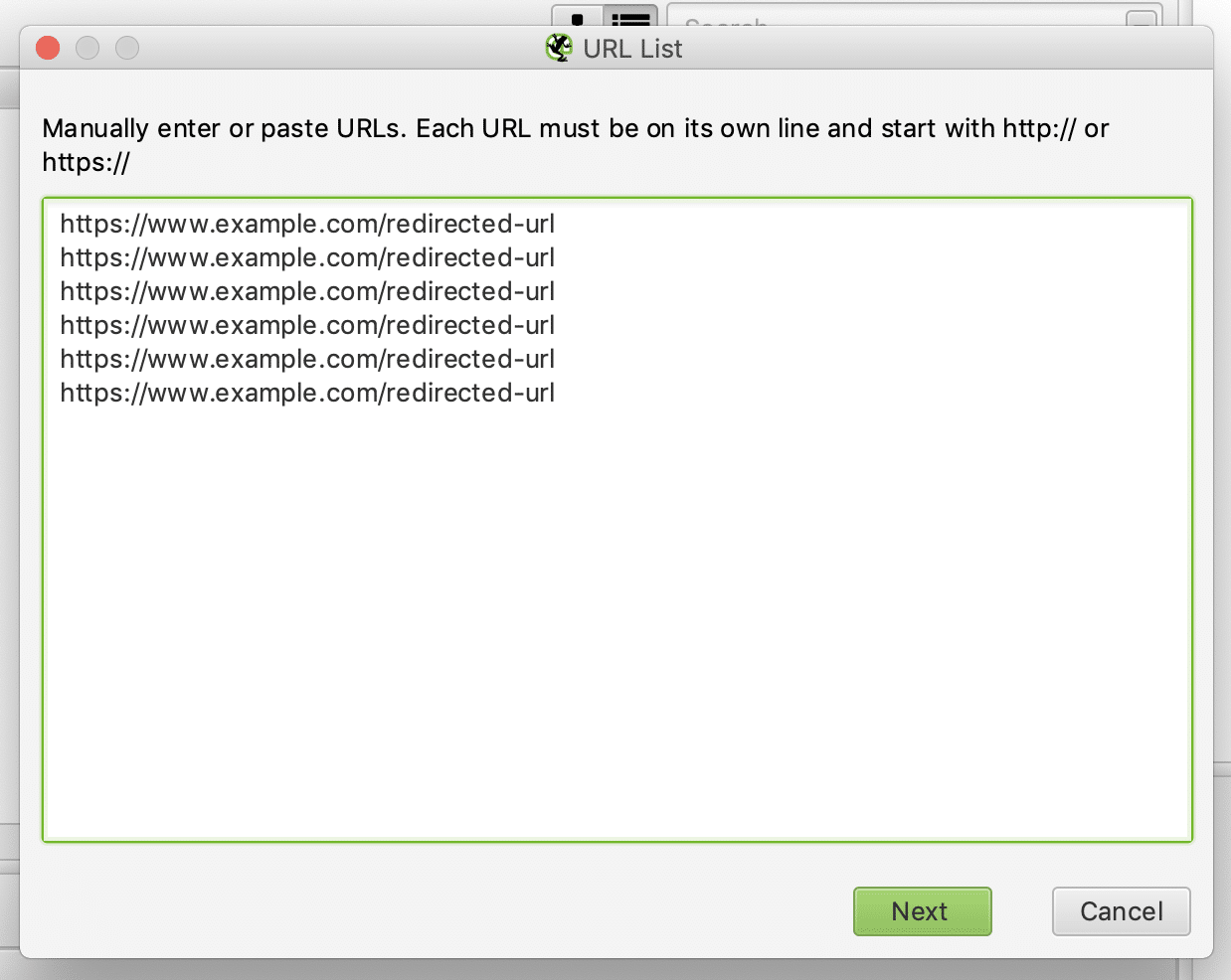
Four faults cause most of the damage: a 302 (temporary) used where a 301 (permanent) was meant, so ranking signals never fully pass; redirect chains, where one URL hops through several before it lands; redirects pointing at a 404; and redirect loops. To check existing redirects, I run the list through a crawler (Screaming Frog, in list mode: Mode > List) and read the response code and final destination of each URL. For quick checks while browsing, a redirect-tracing browser extension does the job - see our guide to the best Chrome extensions for SEO.
5. Crawl errors
In Search Console, open the Page indexing report (it used to be called Index Coverage) and look at anything marked "Not indexed" with an error. A page with an error against it is not in the index, and is not earning you traffic.
Common problems flagged here include:
- Server errors (5xx)
- Redirect errors
- Pages blocked by robots.txt
- Pages marked with a noindex tag
- Soft 404s
- Pages returning a 404
- Crawl issues that stopped Google from reaching the page
Work through them by error type rather than page by page - one root cause usually explains a whole group. Fix the cause, then use the report's "Validate Fix" button so Google rechecks the affected URLs, and the report closes the error off once they pass.
6. Ranking losses
A fall in organic rankings is one of the most common reasons traffic drops. If you run a rank tracker, the diagnosis is quick; if you do not, Search Console's Performance report is your best source.
The process I use:
- Using Search Console, or your rank tracker (mine is AccuRanker), pin down when traffic started to slide.
- Export the ranking keywords from before and after the drop.
- Put the two sets side by side in a spreadsheet.
- Compare the change in position, query by query.
- Win back the lost terms with fresh keyword research and mapping.
| Keyword | Position before | Position after |
|---|---|---|
| Keyword 1 | 3 | 12 |
| Keyword 2 | 5 | 9 |
| Keyword 3 | 2 | 18 |
| Keyword 4 | 7 | 8 |
| Keyword 5 | 4 | 24 |
Looking at the above list, it is good to assume that Keywords 1, 3 and 5 are where the traffic went. A visibility tool such as SISTRIX is also good for spotting terms that have slipped off page one. If you want to go deeper, here are some technical SEO tips to help your site rank.
7. XML sitemap changes
Only URLs that return a 200 response and are indexable belong in your XML sitemap. A change to that sitemap - pages dropped, broken URLs added - can quietly cost you traffic.
Find your sitemap (usually at https://yourdomain/sitemap.xml or https://yourdomain/sitemap_index.xml) and check it in Search Console's Sitemaps report, which shows when it was last read and how many of its URLs were indexed. Crawl the listed URLs and confirm each returns a 200 OK, and that new landing pages and articles are included. If the site has 200 live URLs and the sitemap lists 50, you will need to regenerate it and resubmit it through Search Console.
8. Manual actions and penalties
Google issues a manual action when a human reviewer finds something on your site that goes against their spam policies and search essentials. It is one of the few drops with a single, unambiguous cause and, for most sites, the least likely on this list.
Check the Manual Actions report in Search Console. If it says "No issues detected", then you can move on. If there is an action against your site, the report names exactly what to fix. You can then correct it across every affected page, then submit a reconsideration request. That review will take anything from a few days to weeks.
9. URLs being de-indexed
Sometimes pages simply fall out of the index - occasionally through a Google bug, more often because something on the page or the site told Google to drop them. Losing a few traffic-rich URLs from the index shows up fast in your numbers.
- Check the Page indexing report in Search Console for newly de-indexed URLs.
- Run your important pages through the URL Inspection tool to confirm they are still indexed - it shows the page's exact index status and why.
- If one has dropped out, fix the cause (a stray noindex, a canonical tag pointing elsewhere, a thin or duplicated page), then use "Request indexing" to push it back into the queue.
10. Keyword cannibalisation
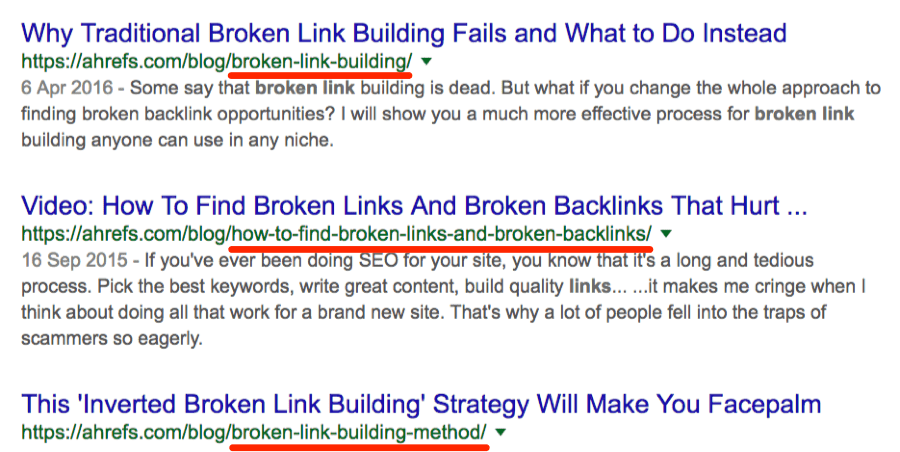
If you have published a lot of content around one topic without mapping the keywords carefully, you may have created a cannibalisation problem. This means that several of your own pages could be competing for the same term.
Source: Ahrefs.
When traffic for a query is split like this, Google has to choose between your pages and tends to rank none of them well. To find it, open Search Console's Performance report, filter to a query, and check the Pages tab - more than one URL from your site is the warning sign. The fix is to consolidate: pick the strongest page, fold the useful content from the others into it, and redirect the weaker URLs to it.
11. SERP changes and AI Overviews
This is the cause that has changed most since I first wrote this post. Your rankings can hold perfectly steady and your traffic can still fall - because the results page now answers more queries without users needing to click on a link.
The biggest single shift is AI Overviews. When Google generates an AI answer at the top of the results, the searcher often gets what they need without clicking through. Informational queries take the hardest hit - the "what is", "how do I" and definition-style searches. If a page that used to rank well for that kind of query has lost clicks but held its position, AI Overviews are the most likely cause.
AI overviews are not the only change however! Featured snippets, the knowledge panel, "People also ask", product grids and ever-larger ads all push the first true organic result further down the page. A position-three ranking earns far less clicks than it did a few years ago.
A search for "digital pr" shows how much the SERP has changed in recent years. Sponsored results, an AI Overview with its own image carousel and source panel, and the usual SERP furniture all load before the first organic listing - which is pushed completely below the fold:
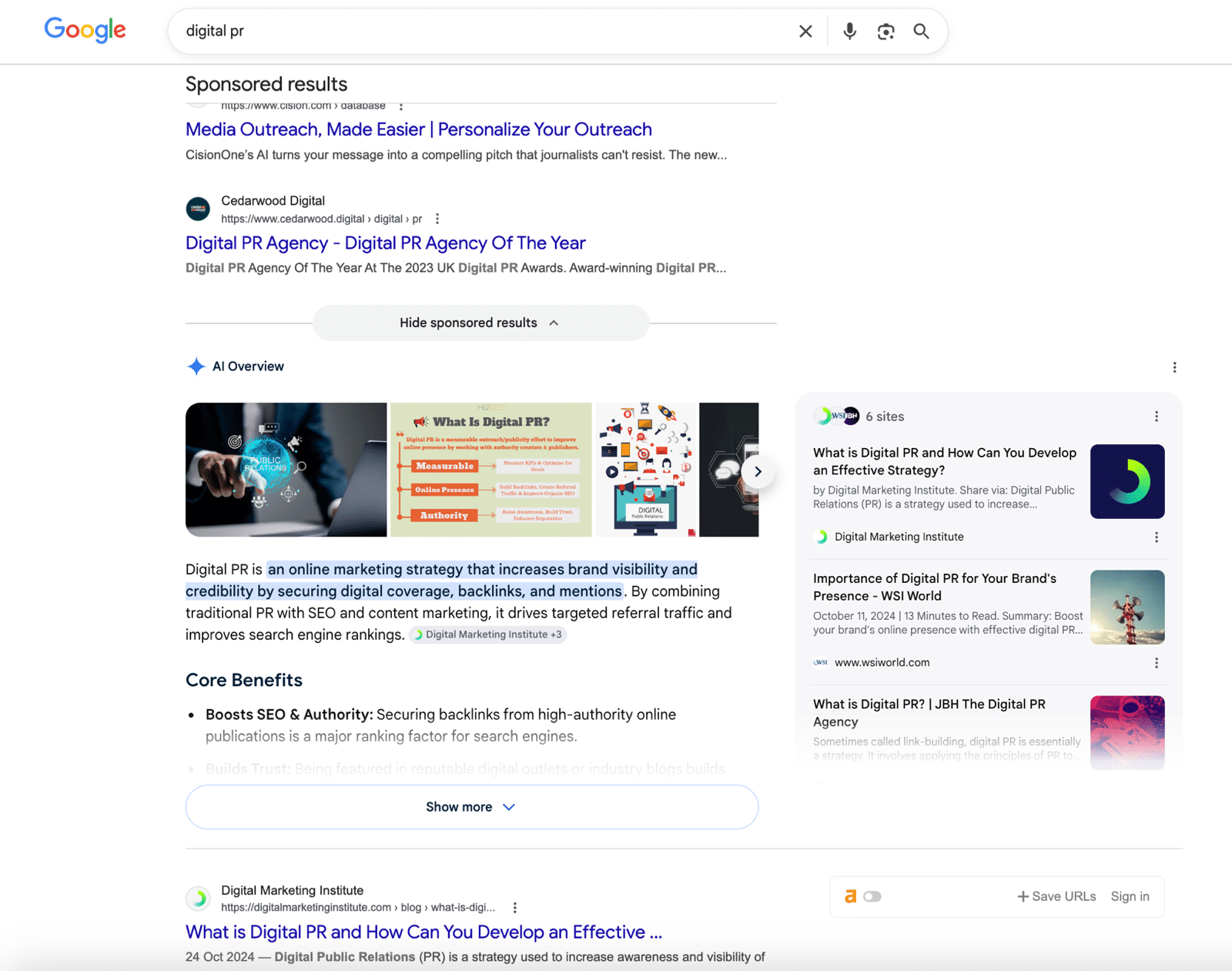
To confirm if the SERP itself has impacted your click through rate, you can compare clicks against impressions and average position in Search Console over the period of the drop. A steady position and impressions with falling clicks points straight at the SERP. Google folds clicks from its AI surfaces into the Performance report's "Web" search type, and its guidance on AI features confirms the SEO fundamentals still apply.
You cannot opt out of this, but you can adapt: lean towards searches that still need a real click - comparisons, opinion, original data, anything transactional - and write pages thorough enough that the AI answer leaves a reason to read on. If you would rather hand this to the specialists, our SEO team does exactly this kind of work.
Frequently asked questions
Why has my website traffic suddenly dropped?
Most sudden drops trace back to one of a handful of causes: a Google algorithm update, a tracking or technical fault, a loss of rankings, or a change to the search results page itself such as AI Overviews taking the click. Work through the 11 checks above and the cause usually surfaces quickly.
Can website traffic drop without losing rankings?
Yes - and it is increasingly common. AI Overviews and other SERP features answer the query on the results page, so you can hold your position and still lose the click. Compare clicks against average position in Search Console: if the position is steady but clicks have fallen, the results page is the likely cause, not your ranking.
How do I diagnose a traffic drop?
Start by confirming the drop is real - check the analytics tag is firing using GA4's Realtime report. Then open Search Console's Performance report and compare clicks, impressions and average position from before and after the drop. Cross-reference the date against Google's Search Status Dashboard to rule an algorithm update in or out.
How long does it take to recover from a traffic drop?
It depends on the cause. A tracking or technical fix recovers as soon as Google recrawls the affected pages this can range from days to a couple of weeks. A core update is slower: Google says it can take several months, and recovery comes from improving the site overall rather than from a single fix.
Is a sudden traffic drop a Google penalty?
Usually not. True penalties are manual actions, they are rare, and they are always flagged in Search Console's Manual Actions report. The vast majority of traffic drops are algorithmic or technical - not a penalty.
Summary
A traffic drop always has a reason, and a reason can almost always be fixed. It might be one cause or several at once - a core update plus a stray redirect, or a single traffic-rich page that has slipped out of the index.
Work through the 11 checks above in order. The cause usually surfaces quickly, and once you can name it, you can build a recovery plan around it - our SEO checklist for optimising web content is a good place to start once the technical basics are sound.
My browser toolbar is a row of Chrome extensions, and most of them earn their place during SEO audits. They check redirects, headings, rendered HTML, page speed and tech stacks without making me leave the page I'm looking at. Over a working week, that saves hours.

This list gets a clear-out every so often. Tools get abandoned, handy features move behind paywalls, and Google quietly retires things like AMP. What follows is what I actually use for SEO work, what each one is good for, and the catches worth knowing before you install.
1. Detailed SEO Extension
If you install one extension from this list, make it this one. Detailed SEO Extension opens a single panel showing the page title, meta description, canonical, indexability, hreflang, heading structure, schema, Open Graph tags and image alt coverage.
On an audit I use it as the first check on any page: is it indexable, does the canonical point where it should, is the heading order sane. Three clicks instead of three tools, and it's genuinely free - no account, no upsells, no tracking.
2. Redirect Path
Redirect Path sits next to my address bar and flags the HTTP status of every page I land on. A 301, a 302, a 404, a sneaky JavaScript or meta-refresh redirect - the icon changes, and a click shows the full chain.
Redirect chains are easy to miss and slow to find by hand. This catches them while I'm just browsing a site, so I spot them long before they reach a report.
3. Link Redirect Trace
Redirect Path tells you a page redirected. Link Redirect Trace, from LinkResearchTools, tells you what happened at every hop - the status code, whether robots.txt blocked it, whether a noindex tag sat in the chain, and how link equity passed along the way.
I reach for it when a redirect is misbehaving and Redirect Path's quick view isn't enough to explain why. It's free; a LinkResearchTools account adds deeper link metrics on top.
4. Ahrefs SEO Toolbar
The Ahrefs SEO Toolbar overlaps with Detailed SEO Extension but brings different strengths: an on-page report, a redirect tracer, a broken-link highlighter, an hreflang checker and a SERP overlay. The core features are free; an Ahrefs subscription adds traffic and backlink metrics on top.
I keep both installed. Detailed for a fast read of one page, Ahrefs when I want broken links surfaced or a closer look at a set of search results.
5. HeadingsMap
HeadingsMap draws the heading structure of a page as a clean outline, so a missing H1 or a jump from H2 straight to H4 is obvious at a glance. It also reveals headings hidden with CSS and follows the HTML5 document outline.
Sensible heading structure helps both search engines and screen readers, and it's one of the quickest on-page checks going. HeadingsMap turns it into a five-second job.
6. View Rendered Source
Modern sites build a lot of their content with JavaScript, and what sits in the raw HTML often isn't what Google ends up indexing. View Rendered Source shows the raw HTML and the rendered HTML side by side, with the differences highlighted.
If a client's key content, internal links or canonical tags only appear after rendering, that's a JavaScript SEO problem worth flagging, and this is the quickest way to see it. Install it from the Chrome Web Store rather than searching for its website - the original domain was lost to a squatter.
7. Quick JavaScript Switcher
Quick JavaScript Switcher turns JavaScript on and off for the current site in one click. It pairs neatly with View Rendered Source: switch JavaScript off, reload, and see how much of the page actually survives.
It's one of the first checks I run in an audit. If the navigation, the main copy or the internal links vanish without JavaScript, search engines are working harder than they should to find them.
8. Wappalyzer
Wappalyzer tells you what a site is built with - CMS, ecommerce platform, CDN, analytics, frameworks, server software. The icon updates as you browse, so a glance tells me whether I'm looking at WordPress, Shopify or something custom.
That matters early in an audit. Knowing the stack tells me which fixes I can hand straight to a client and which will need a developer.
9. Wayback Machine
The Internet Archive's Wayback Machine extension does two useful things. When a page returns a 404 or another error, it offers the most recent archived version instead. On any live page, it gives one-click access to how that URL looked at points in the past.
I use it to see what a page said before a client redesign or migration, to recover copy that was dropped along the way, and to check when a competitor changed direction.
10. META SEO Inspector
META SEO Inspector reads all the metadata on a page without sending you into the source code: title, meta description, canonical, robots directives, Open Graph, Twitter cards, structured data and more. It flags anything missing or malformed as it goes.
Detailed SEO Extension covers a lot of the same ground. META SEO Inspector earns its keep when I need to pick apart exactly how one page is marked up.
11. Check My Links
Check My Links crawls every link on the page you're viewing and colours them in: valid links green, broken ones red. There's no report to read - you just see the problems.
It's quick for catching broken internal links during an audit, and it's a long-standing favourite for broken-link building - find a dead link on someone else's page, then offer your content as the replacement.
12. Hreflang Tag Checker
If a site serves more than one language or country, hreflang tags are easy to get wrong and hard to check by eye. Hreflang Tag Checker reads the whole hreflang cluster for a page and validates it: are the language and country codes valid, does each version point back, is the page referencing itself.
SEO Minion, further down this list, runs a basic hreflang check. This one goes further by following the return links across every alternate version, which is where most hreflang problems actually hide.
13. MozBar
MozBar shows Moz's Domain Authority and Page Authority on any page or set of search results, alongside link metrics and a quick on-page overview. It's a fast way to size up a domain or read the competition in a SERP.
Since early 2025 the free version is much tighter. DA and PA are still free within a monthly limit, but most of the deeper analysis now needs a paid Moz Pro account. For authority scores at a glance, the free tier still does the job.
14. SEOquake
SEOquake, made by Semrush, overlays SEO metrics on every search result - domain and page-level scores, backlink counts, traffic estimates and domain age. It also runs a quick on-page audit, shows keyword density, and exports a SERP to CSV.
It covers similar ground to MozBar, with one practical edge: that CSV export. When I want a search results page as a spreadsheet to work from, SEOquake gets it there in a couple of clicks. The core features are free.
15. SEO Minion
SEO Minion is a free, no-login bundle of small jobs that would otherwise take several tools. It runs an on-page analysis, checks hreflang, previews how a page looks in the SERPs, finds broken links, and simulates a Google search from another location.
The location simulator earns its place on its own. Rankings shift by country and city, and checking them from where the user actually sits beats guessing.
16. SimilarWeb
SimilarWeb gives a fast read on any site's traffic: estimated visits, where they come from, top keywords, the geographic split, and - more recently - how much of that traffic arrives from AI tools like ChatGPT.
The numbers are estimates, so I treat them as direction rather than fact. For sizing up a competitor or a prospect before a deeper look, they're a useful starting point.
17. Tag Assistant
Google's Tag Assistant checks whether your Google tags are firing correctly - Google Analytics 4, Google Ads and Tag Manager. It records a session, then shows which tags fired, in what order, and with what data.
Tracking that looks fine but isn't is a quiet, expensive problem. Tag Assistant is how I confirm a GA4 or Tag Manager setup is doing what the client thinks it is. If you remember the old Tag Assistant Legacy extension, this is its replacement.
18. User-Agent Switcher and Manager
User-Agent Switcher and Manager loads a page as a different browser, device or crawler. Switching to a Googlebot user-agent shows roughly what Google is served; switching between mobile and desktop is quicker than resizing a window.
Chrome's built-in device mode covers some of this, but for a fast user-agent swap mid-audit a dedicated extension is less fiddly. The long-standing favourite used to be "User-Agent Switcher for Chrome" - this is the actively maintained one to use now.
19. Data Scraper
Data Scraper - you may know it as Data Miner - pulls structured data such as tables, lists and search results off any web page and drops it into a spreadsheet, no code required. For SEO I mostly use it to grab URL sets from search results, whether that's mapping what Google has indexed for a client or building a quick competitor list.
20. Keyword Surfer
Keyword Surfer, from Surfer SEO, drops search volumes, CPC and related keyword ideas straight into Google's results pages. It's the obvious free counterpart to Keywords Everywhere - Surfer has committed to keeping the core data free, with no account needed.
It won't replace a proper keyword research tool, but for a quick sense of demand while you're already looking at a SERP, it does the job at no cost.
21. Keywords Everywhere
Keywords Everywhere shows search volume, CPC and competition data inside the results pages of Google, YouTube, Search Console, Google Trends and plenty of other sites. It's useful context while you're already looking at a SERP.
It stopped being free back in 2019, though. It now runs on paid credits, so it's only worth installing if you'll use it enough to justify the cost. For lighter use, Keyword Surfer above covers much of the same ground for nothing.
What dropped off the list
A few extensions that earned a place in older versions of this post have gone:
- The Lighthouse extension - the audit itself is as useful as ever, but the standalone extension was retired. Lighthouse now lives inside Chrome's developer tools: press F12, open the Lighthouse tab, and run it from there.
- AMP Validator - Google stopped treating AMP as a ranking factor and dropped the AMP requirement for Top Stories. Unless a site still actively serves AMP pages, there's little reason to check them.
- Standalone Google Analytics debuggers - most were built around Universal Analytics, which stopped collecting data in 2023. Tag Assistant covers GA4 debugging now.
- Open SEO Stats - it still installs, but it's looking dated, and the all-in-one extensions at the top of this list now cover the same quick checks more reliably.
Get more from your browser
That's the working set - the extensions I reach for on a real audit, not a list assembled for the sake of one. Install the ones that fit how you work, and your browser will do more of the legwork for you.
Want the audit without the toolbar? Aira's SEO team does this for a living, technical SEO included. And once you've made your fixes, our SEO checklist is a good way to keep pages in shape.
55% of businesses are now using AI to create PPC (pay-per-click) ad copy. AI can create thousands of ad variations, so we should all be using AI to write Google ad copy, right?
We aren’t convinced.
Where is AI used when creating ad copy?
AI can be handy for brainstorming when you feel a bit stuck for ideas and there are two distinct times in an ad account where you can feel like you don’t know where to start:
- Starting with a new client
- Building ads on an old account
New accounts
When you haven’t worked on the account yet, you don’t know what ad text will resonate best with that audience. Buyer personas and competitor research can help here, but for a dash of inspiration, AI can be a good tool. Once you’ve defined your target persona, you can feed that into AI with a prompt to generate ad text ideas from this and build on them based on the competitor research you’ve done.
Old accounts
On the opposite side of the spectrum is a client you’ve been working with for years. We are very lucky to have clients who have been with us for 5+ years. The trust this shows in the work we’re doing is amazing. However, when you’ve been working on an account for so long, a little inspiration is never a bad thing.
In this instance, your ad text might feel stale, or you may have run out of ideas for the target personas. Using AI can help shift your thought process and help you see things differently. It can sometimes give you a fresh perspective and maybe find another angle for your ads that you hadn’t thought of before.
The best AI prompt for creating Google Ads
The prompt is incredibly important when using AI. Asking AI to create 15 headlines and 4 descriptions has varying levels of success, with the majority of headlines sounding too similar to be used.
However, it gives a starting point. Here’s something to get the wheels going and the cogs turning:
If you put this into your preferred AI tool, you’ll notice that the headings and description are really generic. This is fantastic news. Now we know which headlines and descriptions are too generic, not attention-grabbing enough or too similar to use in these campaigns.
With refinement of the prompt, there’s a chance you might get some usable bits and pieces. However, we actually use it to find out which headlines and descriptions aren’t good enough, so that we can skip thinking about these and start producing the best ones for our ad campaigns.
The limitations of using AI for ad copy
01Keyword integration and intelligence
Google Ads keywords are given a score out of 10. This is known as your quality score, which is made up of 3 metrics:
Ad relevance is ⅓ of your quality score, meaning it’s very important that your ad text matches your keywords. These keywords need to be woven into your ad copy effectively so it doesn’t read like the keywords have been forced into it.
Our experience with AI is that keywords aren’t cleverly woven into ad copy, but rather, hammered in wherever possible, making them glaring and unnatural. This may not bring your quality score down in the eyes of Google much, but it can bring the quality down in the eyes of the humans you’re trying to reach.
02Distinguishing between types of campaigns and platforms
There are so many avenues that ad copy can go down, depending on whether your ads are for brand awareness, remarketing, or if they’re conversion-focused. From our experience with AI, it’s difficult for it to distinguish between the three. This means that ads are generic, and generic ads do not perform well with a human audience.
This goes further, though. Each ad will vary depending on the advertising platform used and the outcome expected from that ad. People expect different language on different platforms, and with AI, it’s very difficult to customise ads for each platform and audience.
03Pulling the right information
In a perfect world, the landing page we’re sending people to would mention everything you need to include in the ad, and it would be easy to feed this into AI to get a better output.
In reality, a lot of our clients run paid ads while we work with them to develop their landing pages for paid and SEO. This means the page we’re sending ads to may not be the perfect environment for AI to pull from at the beginning of a campaign. Without this context, it’s very likely that AI will miss crucial elements. While you can provide AI with context, it’s often easier to do the thinking yourself.
04Built-in AI test
Google Ads recently added Gemini into the ad creator, which pulls headlines and descriptions into your ad based on the URL you’re sending to. This sounds like a great time-saver, but as we mentioned above, if the landing page isn’t perfect, the ad text won’t be. Gemini doesn’t target these towards your brand, focus product or audience. Instead, it pulls what it thinks are relevant headlines from the page. As you can see, it’s hit and miss:
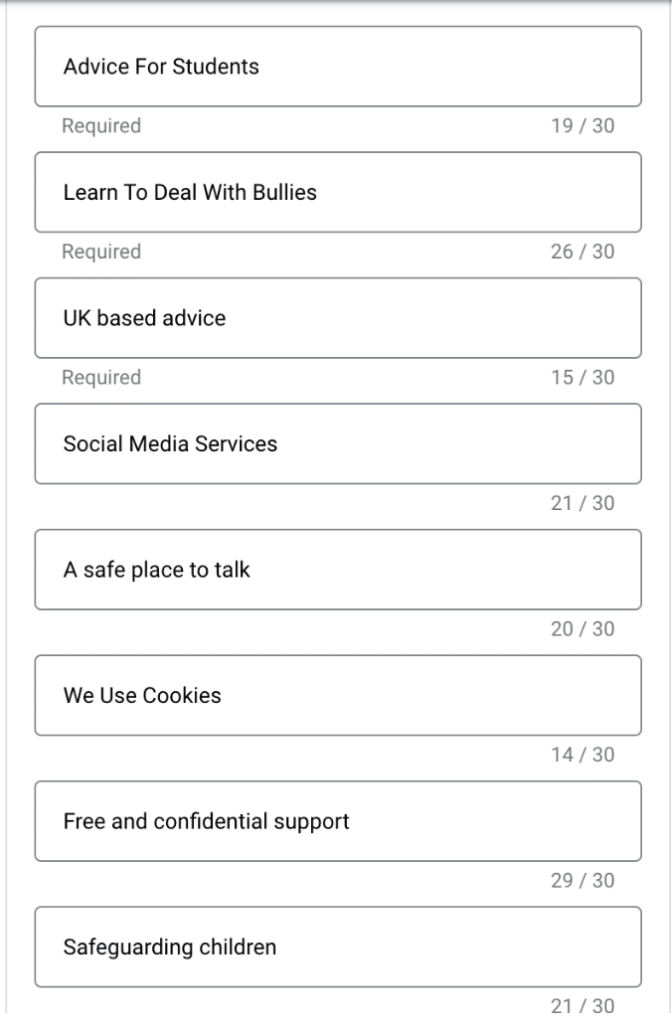
It’s important to create an ad that includes all the key points the client needs, not just include what’s on the page - like AI did above. Yes, this client uses cookies, but as you can probably guess from the other keywords, that isn’t really relevant for an ad.
Without refinement, the campaign above will miss the key points the client needs it to hit, resulting in missed opportunities and wasted ad spend. Creating a truly effective campaign requires an understanding of the client, the audience and what is trying to be achieved.
So far, AI cannot replace human creativity in any of these aspects.
Is AI actually faster for creating ad copy?
One of the biggest misconceptions of AI is that it’s fast. In reality, it’s only fast if you have a very specific and detailed prompt. A prompt that needs to be different for every client, campaign, product and target persona. If not, your ad copy won’t hit the mark.
If a new campaign needs to be created or a new client is coming on board, AI is great for ideas and is a brilliant place to start getting insights and inspiration. For those initial ideas, AI is faster, especially if you haven’t worked in that sector before.
But as we’ve demonstrated above, it’s never perfect and always needs creative input from an ad specialist.
Most of our work as ad specialists goes into refining an ad. After you’ve written a full ad with 15 headlines and 4 descriptions, some ad text will work and some won’t. Our job is to refine and replace poorly performing ad text with a variation of the best-performing ad text. At this point, you have a good understanding of the client, their business, their goals and audience, so it’s easier to write this yourself while you are in the ads interface.
So, where does AI fit into ad creation?
We started this piece by saying that 55% of people are now using AI to create ad copy, and then spent most of it explaining why we aren’t using it as much as most.
The fact that AI can create thousands of variations for ad text and even images, in seconds, means it’s undoubtedly faster than any human. However, from our tests, it cannot replicate the human element needed to drive the right results for our clients. No matter the prompt you use, at the moment, AI doesn’t understand your campaign goals, your client’s business goals and their audience as well as a human.
For this reason, we’ll stick to using AI for inspiration and use human creativity to research, refine and reach our target audience. Want to chat about paid some more? Get in touch!
There’s no set formula for creating the perfect viral social media campaign. And this is reflected in the crazy, heartwarming, inspiring and hilarious brand stunts that hold the top spots for best social media campaigns of all time.
The most viral social media campaigns ever
1. ALS Ice Bucket Challenge (2014)
- Platforms: Facebook, YouTube, Instagram.
- Impact: Raised over $115 million for ALS research.
- Why it worked: Participatory, simple, celebrity-backed, highly shareable
In the summer of 2014, the ice bucket challenge took over the internet to help raise awareness for ALS (a disease that affects nerve cells in the brain and spinal cord).
It all started when three guys living with ALS (Anthony Senerchia, Pete Frates, and Pat Quinn) took the Ice Bucket Challenge and launched a global campaign that over 17 million people took part in.
People across the world copied, posting their attempts on social media and challenging their own friends and family to do the same. With big stars such as Taylor Swift, Eminem and David Beckham also taking part, the social media trend made a huge impact, as over $115 million was raised for ALS research.
We’re even betting there’s a grainy old video of you doing this challenge somewhere on social media, but how was this campaign so successful? It was a simple concept which had full support from celebrities and the press. Not only that, but it was as easy to participate in as it was to share on social media.
2. #ShareACoke by Coca-Cola (2011-ongoing)
- Platforms: Twitter, Instagram, YouTube
- Impact: Personalised bottles created a social sharing frenzy
- Why it worked: Customisation + nostalgia + user-generated content.
The ongoing #ShareACoke campaign replaces the traditional Coca-Cola logo with popular names and nicknames adapted for a range of cultures. The brand encourages consumers to not only look for their own name but share the personalised bottles with their friends and loved ones.
Remember when these bottles first hit the shelves? The chaos? You couldn’t get to refrigerators in shops to look for your name on the label, let alone find it! It was pandemonium - for a bottle that we’d all seen before, but this time it had our names on it.
This simple yet genius use of marketing shows that a bit of customisation goes a long way. It drives user-generated content for the brand, fosters a sense of community amongst audiences and makes you billions of dollars!
3. Nike – ‘Dream Crazy’ (2018) featuring Colin Kaepernick
- Platforms: Twitter, YouTube, Instagram.
- Impact: Huge engagement and polarised debate; boosted Nike's sales.
- Why it worked: Bold stance on social justice; emotionally charged storytelling.
Nike’s 2018 ‘Dream Crazy’ campaign was fronted by American civil rights activist and former professional American football quarterback Colin Kaepernick, who caused a national debate by kneeling during the national anthem to protest racial injustice. The use of the athlete sparked debate across social media, with some people posting photos and videos of themselves burning their Nike merchandise.
The campaign was a huge success due to its emotionally charged storytelling and the brand's commitment to sharing its stance on social justice. Overall, the ‘Dream Crazy’ campaign encouraged audiences to reflect on their own beliefs surrounding injustice and didn’t do too badly for Nike’s bank balance either.
4. Spotify Wrapped (Launched 2016, viral every December)
- Platforms: Instagram Stories, Twitter.
- Impact: Drives mass UGC and app re-engagement.
- Why it worked: Personalised data + aesthetic shareable content + viral gold
Despite only starting in 2016, Spotify Wrapped has quickly become a well-loved tradition for many on social media in the lead up to the new year. Every December without fail, Spotify goes viral with users sharing their most listened to music on the platform.
In 2024, Spotify managed to go double viral when it delayed the release of Wrapped. This got people talking and made audiences even more eager to reveal their listening habits, as Wrapped playlists were shared over 30 million times across Instagram, TikTok and X!
This level of user-generated content is unheard of normally and is driven by the use of personalised data and aesthetically pleasing shareable content. And us being very nosy about what other people listen to.
Following its major success, it is clear that many other brands are attempting to follow in the footsteps of Spotify by creating their own version of “Wrapped”, such as Letterboxd and Monzo. But I don’t think that any of these can replace the original, and we can’t wait to welcome it back for years to come!
5. Dove’s Real Beauty Sketches (2013)
- Platforms: YouTube, Facebook.
- Impact: One of the most viewed video ads ever, reshaped brand perception.
- Why it worked: Emotionally resonant, focused on self-perception.
This influential social media campaign was a short film produced by Dove in 2013. It featured a forensic sketch artist drawing illustrations of women who had described themselves, followed by sketching the same face but from descriptions of a stranger who had just met them.
Overall, the campaign is deeply moving and emotional, showing how we are overly critical of our looks. A trait that would resonate with a large number of audiences. The campaign became one of the most viewed video ads of all time and helped to redefine the conventions of marketing in the beauty industry.
6. #LikeAGirl by Always (2014)
- Platforms: YouTube, Twitter.
- Impact: Challenged gender stereotypes; Emmy and Cannes Lion winner.
- Why it worked: Empowering, deeply emotional, socially conscious.
This female empowerment campaign challenged the negative connotations that come with the phrase “Like a girl” and highlighted the drop in confidence that occurs for girls after they have experienced puberty.
Always produced an emotional, socially conscious campaign that resonated with a large audience globally - this resulted in it becoming an Emmy and Cannes Lion winner as well as tripling their following on Twitter in the first three months.
The #LikeAGirl campaign proves that marketing can make a long-lasting impact on society's perception of people and how capturing real emotions helps a brand to build stronger connections with audiences.
7. Red Bull Stratos (2012)
- Platforms: YouTube, Facebook.
- Impact: 8 million concurrent viewers, broke livestream records.
- Why it worked: A man jumped from space, Need we say more?
Red Bull is known to love an adrenaline rush, often sponsoring or hosting events for extreme sports. However, nothing is more extreme than Stratos. For Austrian skydiver Felix Baumgartner, the brand's famous slogan “Red Bull Gives You Wings” really was the case. In 2012, the brand supported a space-diving mission, in which Baumgartner made a record-breaking freefall jump from the stratosphere!
This daring campaign got the audience's hearts pounding as the brand broke livestream records with 8 million concurrent viewers and now has over 1 billion views on YouTube. But what made it so successful? Well, a dude jumped from space and reached terminal velocity! Need we say more?
8. #ThisGirlCan by Sport England (2015)
- Platforms: Twitter, Instagram, Youtube.
- Impact: Inspired over 2.8 million women to be more active.
- Why it worked: Body-positive, inclusive, real-life stories.
Sport England’s #ThisGirlCan campaign celebrated real women getting active - sweating, moving and pushing past stereotypes. It defied the conventions of traditional fitness marketing by featuring women of all shapes, sizes and backgrounds, creating a body-positive message that inspired over 2.8 million women to be more physically active.
It’s not tricky to see why this campaign went crazy viral. It gave women who weren’t used to being represented a voice. It’s inclusive and life-like storytelling influenced a social media movement of empowerment and health across YouTube, Instagram and Twitter for women across the world.
9. KFC's Twitter Stunt (2017)
- Platform: Twitter.
- Campaign: They followed only 11 people - 5 Spice Girls + 6 guys named Herb.
- Why it worked: Humorous and genius-level brand play.
In 2017, Twitter users began to notice that the brand KFC only followed 11 people. Which 11 people? 5 Spice Girls and 6 guys named Herb. This playful campaign was a genius nod to their famously secret recipe, which uses 11 herbs and spices.
However, what we love most about this campaign is how under-the-radar it was. It was a Twitter user who noticed it; KFC didn’t have to lift a finger. Well, other than to follow the spice girls and some herbs.
The initial tweet from the user who first spotted this has generated over 320,000 reposts and 700,000 likes. KFC’s campaign, that was never really a campaign, has proven that even the simplest of details combined with humour can create the perfect trending social media campaign.
10. Wendy's Twitter Roasts (Ongoing)
- Platform: Twitter
- Impact: Reinvented brand voice for fast food
- Why it worked: Bold, savage, ultra-memable - reshaped how brands behave on social
From beefing with McDonald’s to their witty puns, Wendy’s has used humour to capture the attention of millions of Twitter users. Their savage tweets have reinvented how brands communicate with their audiences on social media, showing that total professionalism isn’t always a way to win customers! By creating memorable yet consistent content, this fast food chain has engaged younger audiences and repeatedly earned viral status.
Now, many have tried and failed to replicate Wendy’s Twitter roasting. So be very careful trying to roast your own customers; it could just backfire. If anything, though, that’s why it’s this campaign is so impressive; it somehow worked without anyone getting too angry.
The takeaways from these viral moments
Whether it’s a global movement that encourages audience participation like the Ice Bucket Challenge or creating a playful brand voice that breaks industry stereotypes like Wendy’s viral tweets, each of these campaigns shares some common traits; they evoke emotion, from simply making people laugh or inspiring change.
These campaigns are centred around their target audiences' experiences and emotions. They are packed full of sass, in some cases, and are never afraid to be bold. Were they lucky or were they strategic, though? That’s probably a discussion best saved for another day.
Well, other than Mr Baumgartner falling from the edge of space! There had to have been some luck involved in that one!
Executive summary
The online landscape is changing rapidly, with AI-powered search, evolving trust signals and a change in consumer behaviours transforming how people find information and make decisions online. The travel industry in particular has been affected by these changes, with consumers increasingly relying on AI tools to research and plan their trips.
This means that travel brands must rethink how they earn visibility online in this increasingly competitive, fast-moving environment. As a result, understanding how to use digital PR effectively has never been more important.
The state of digital PR in the travel industry report brings together insights from senior digital PR professionals, in-house travel marketers and travel journalists to explore how digital PR is used across the travel industry and why it’s set to become even more important in 2026.
Key findings from the report
- There's a rising demand for digital PR from travel brands, which is set to make the space more competitive: 81% of travel marketers believe digital PR will become even more important in the next 2-3 years
- Data-led campaigns are still the most popular tactic for earning coverage and links, but are becoming harder to execute: There is now more emphasis on unique and robust data, originality and stronger methodologies. Seasonality is also key with data-led campaigns.
- Reactive PR is becoming increasingly relied upon: Reactive PR and timely expert commentary are key to securing coverage in a fast-paced, competitive travel media landscape.
- Personalised pitching is now essential: Journalists expect pitches tailored to their area of expertise, their audience and the publication.
- The biggest challenge for digital PRs in the travel space is landing coverage: AI is helping to alleviate some of this through inspiring outreach angles and sense-checking emails.
- Digital PRs aim for quality over quantity with coverage: Almost half of travel digital PRs consider a campaign successful if it secures 0-9 pieces of coverage, and relevance of coverage is the most popular reporting metric, used by 90% of digital PRs.
- Digital PR coverage is being tied to wider benefits by only half of travel marketers: These travel marketers are mostly focusing on ranking improvements, increase in traffic to site and search visibility. A minority are tying digital PR coverage to revenue. However, there is a shared agreement that digital PR is highly effective for SEO and GEO.
- The top predictions for travel digital PR in 2026 include:
- A transition from destination hype to value and relevance: Answering real consumer concerns this year, including convenience, affordability, safety and value
- A need to reflect the consumer's desire for more personalised experiences: It will be crucial for digital PRs to fully understand the different target audience segments and create tailored, targeted stories
- Human-led, story-first PR: To stand out in a world of AI-written content
- Hyper-relevance and targeted outreach will be even more important: To land coverage on key, relevant publications
Table of Contents
Introduction: the state of digital PR in the travel industry 2026
Travel brands are operating in a rapidly changing competitive environment, with AI-powered search, zero-click results, and evolving trust signals redefining how brands earn visibility and credibility online. At the same time, the search landscape has evolved the way consumers find their travel related inspiration, plan their trips and make their bookings or purchases.
With these changes already underway, the need to understand digital PR’s impact and evolving role has never been more important to support online business growth.
The state of digital PR in the travel industry 2026 report brings together insights from experienced digital PR professionals, travel journalists and seasoned in-house marketers working across one of the fastest moving sectors in search marketing. It explores how digital PR is currently delivered across the travel industry, and how those approaches should shift in 2026.
Why digital PR in travel matters now
Digital PR has come back into the spotlight over the past 18 months or so, thanks to the rise of generative AI. Alongside a solid technical foundation and fantastic content, brands need digital PR to support GEO - strengthening visibility in AIOs and LLMs like ChatGPT and Gemini - as well as still supporting traditional SEO. This is because digital PR helps build brand mentions and links which are used as a measure of trust and topical authority by these systems.
This is particularly important for the travel industry because 84% of people globally are planning to use AI when preparing for trips in the future. That said, it does appear to still be the younger generations who are most comfortable with AI. The same YouGov survey found they are using it for a range of travel planning tasks from helping choose destinations, activities and places to stay through to full personalised itineraries.
This highlights that AI is going to be a key part of the buyer’s and search journey moving forward, and therefore where travel brands need to be visible if they want to compete.
In fact, the vast majority of digital PR professionals expect digital PR to become even more critical for travel brands over the next 2 to 3 years, with 81% of survey respondents believing its importance will grow. Only 14% expect the importance to remain the same, which suggests that even those not predicting growth, still see digital PR as an essential part of marketing. This also demonstrates that there’s minimal concern about the long term relevance of digital PR.
What do you think about the importance of digital PR for the travel industry over the next 2-3 years?

of travel marketers believe digital PR will become more important in the next 2-3 years
One of the main challenges over the past year has been adapting rapidly for visibility in Search. AI has also shaped the way users think, the intent behind the search and as a consequence, their queries, in a much more conversational way. The PR and digital PR world has a huge importance for a brand showing up in Search and Google News and on other websites alike. We have to keep in mind that digital PR is a pillar, for the trust of a website, and for increasing referrals and, in turn, uplifting financial revenue.
We’re seeing a shared understanding that digital PR is no longer just about links. Brand mentions, trust signals and earned visibility across search and AI platforms are becoming key to long-term growth for travel brands.
Rising demand for digital PR is making the travel space more demanding
Worldwide search interest in digital PR has increased by 34% since 2020, with the UK up 49% and the US up 32% over the same period. Demand for digital PR in the travel sector is just as strong, with 57% of respondents reporting an increase in demand over the past 12 months.
In your experience, how has the demand for digital PR from travel brands changed over the past 12 months?
| Increased | 57% |
|---|---|
| Stayed the same | 33% |
| Decreased | 10% |
This suggests that travel brands are already becoming increasingly driven by the need for high-quality coverage and increased visibility, due to an intense competitive online landscape.
But what tactics are digital PRs using to drive this high-quality coverage and which are most effective?
Data-led content campaigns still dominate
Data-led content campaigns are the most popular tactic for earning coverage and links in the travel sector, with 95% of respondents using them. This highlights the value of credible, data-backed stories when it comes to securing high-quality media coverage.
When asked to select the most effective tactics for earning coverage and links, respondents also prioritised data-led content campaigns, with 67% choosing it as their top choice and a further 33% selecting it as their second choice, further reinforcing its role as the most impactful approach when it comes to gaining coverage.
Other common tactics and techniques include newsjacking/reactive PR and responding to journalist requests (e.g. HARO, Qwoted etc), with 71% of respondents using these approaches to earn coverage and links. This could reflect the travel media’s need for expert insight for relevant stories, such as travel trends. But tighter budgets have also led to a shift in priorities, with many now relying more on reactive and newsjacking tactics, with high-budget data-led campaigns often executed on an ad-hoc basis rather than part of the retainer.
Thought leadership campaigns are used by 62%, while other tactics like link reclamation, resource outreach, and long-form guides are less common.
What digital PR tactics and techniques do you use for earning coverage and/or links?

| Data-led campaigns | |
|---|---|
| Newsjacking / reactive PR | |
| Journalist requests | |
| Thought leadership campaigns | |
| Data & thought leadership on category pages | |
| Link reclamation | |
| Resource page / blog outreach | |
| Data & thought leadership stories tied to products | |
| Long-form guides | |
| Brand news / profiling | |
| Guest posts | |
| Press releases | |
| Product swaps / free services for coverage | |
| Social media promotion of stories | |
| Product or 'experience' placement | |
| PR stunts | |
| Influencer outreach | |
| Other |
Traditional stunts and influencer outreach were not selected as being used at all. This indicates that data or thought leadership stories, or those that are less risky in delivering an ROI like reactive/newsjacking, are more likely to be chosen by digital PRs today. At the same time brand authority is playing a bigger role, particularly as AI search engines increasingly prioritise trusted sources - so the choice of tactics are likely reflecting this shift too.
One of the most notable themes to emerge is that while data-led content remains the most effective digital PR tactic, it is becoming harder to execute well.
There is now more emphasis on unique and robust data, originality and stronger methodologies. At the same time, the travel sector has become increasingly oversaturated with data-led campaigns, making other tactics often easier to place.
Data-led campaigns can still be really effective, but only when they genuinely reveal something new. Journalists are looking for originality and credibility. They’re asking tougher questions about where the data comes from and what it actually shows, which makes a robust methodology more important than ever.
As search increasingly favours authoritative, trusted sources, questionable datasets and methodologies will quickly lose traction. The strongest travel campaigns today combine solid data with a clear methodology, and answer one key question: why this matters to the travel audience.
Content-led campaigns follow a defined delivery cycle
When it comes to turnaround times for data-led or thought leadership campaigns, 81% of PRs deliver to the client within four weeks, with over half (52%) working to a 3-4 week turnaround. Only a small minority deliver in under a week or over five weeks, suggesting there’s a well-established planning cycle for content-led campaigns across the industry.
These findings suggest that while demand for these types of campaigns continues to grow, PRs that can deliver consistently within a refined delivery cycle will be better positioned to achieve results in an increasingly crowded landscape.
Seasonality continues to influence how travel PR campaigns are planned
Seasonality continues to influence how travel PR campaigns are planned and executed, with clear patterns emerging around both timing and tactics.
PRs tend to align their campaigns with seasonal travel trends and consumer behaviours. For example, wellness and trend-led content in January, family and beach holidays in summer, and winter sun and skiing towards the end of the year. However, for evergreen campaigns, in order to be more timely, seasonality is often reflected in the pitch email and angles used rather than changes to the content itself.
Others note that reactive opportunities spike during the peak travel months with more media requests, so in quieter off-peak seasons, smart planning and looking ahead at emerging trends is important to maintain relevance and consistency in coverage.
Overall these findings highlight that while travel PR is needed throughout the year, it needs to adapt to seasonal trends and reactive opportunities to ensure campaigns remain timely and relevant.
But what techniques are PRs using to ensure their stories gain traction with journalists?
PRs are prioritising tailored, personalised pitches when reaching out to press
When pitching to journalists, most PR professionals opt for a personalised approach, with 67% of respondents sending lightly tailored pitches, which include the journalist’s name and small details about their publication.
A further 24% go beyond this, with heavily tailored pitches including suggested headlines and angles specific to the journalist’s audience. Only 10% use a wider, generic approach. This highlights a widespread belief that customising pitches can increase the chances of coverage.
Which of the following best describes how you usually send your journalist pitch emails?

| Lightly tailored to each journalist | 67% |
|---|---|
| Heavily tailored to each journalist | 24% |
| Wide net / generic approach | 10% |
| Press release or wire blast | 0% |
These findings are also reinforced by Buzzstream's 'Spray and Pray Study', which analysed over 31 million emails. The study discovered that personalised, more focused outreach dramatically outperforms generic pitching, with higher engagement and links, while ‘spray and pray’ campaigns see lower open rates and significantly fewer links.
Some of the travel journalists we spoke to reinforced the need for more heavily tailored pitches, showing an understanding of the publication and the journalist’s area of expertise:
Most of the emails I receive from travel PRs go straight to my trash because they aren’t remotely relevant to my areas of expertise. The ones that don’t go to trash come from PRs who know what I write about and the titles that I write for. It would be great to see more brands sharpening their focus and cultivating more meaningful relationships.
He also added that “An exclusive, or an inside line” could help - reinforcing the need for PRs to do their homework and suggest an exclusive story which could work for the specific journalist.
Most PRs also include additional materials alongside their pitches, with approximately half including a press release (52%), and expert profiles (48%).
Visual assets are also common, with 38% including brand imagery, 33% including infographics, and 19% including stock imagery.
Do you send anything to accompany a pitch?

| Press release | |
|---|---|
| Expert profile | |
| Brand imagery | |
| Infographics | |
| Stock imagery | |
| Other | |
| N/A - I don't send anything |
Hayley Minn, Deputy Travel Editor at the Daily Mail, added that “Great pictures” can help alongside a strong PR story.
However, despite them being widely shared, journalists are using them less than in the past, with over half of PRs (52%) reporting that journalists use their imagery less than before, and a further 29% note that journalists used to use them but no longer do. This suggests that journalists are increasingly selective over what they actually use, reinforcing the need for relevance, quality, and editorial value.
We’ve found that large portions of the budget go toward design-led collateral that journalists rarely reference or link to. While creative assets can be valuable, they don’t always justify the level of investment allocated to them. A more balanced approach, with costs tied more closely to what actually drives coverage and links, would be welcomed.
Speed is critical for reactive PR opportunities
When responding to journalist requests or reactive opportunities, speed is a clear priority.
The majority of respondents (71%) typically respond within half a day, with 43% responding within 2 hours or less. This tells us that most PRs recognise the fast paced nature when it comes to reactive news stories and the need for timely responses for the best chances of securing coverage.
We know journalists are busy. We also know that when a breaking news story drops, it’s all hands on deck to provide the best value content to an audience. As PRs, we have access to experts who can supply commentary or data that elevates a story. After all, journalists are looking to make their stories the most credible and helpful too. If we have this information to hand within a few hours, our chances of landing coverage greatly increases. We recommend having a bank of quotes, across a range of topics, that can be tweaked here and there towards the story, to add a unique spin, speeding up response time.
In addition to supplying expert commentary, speed is also critical for other aspects of the PR-journalist relationship. Speaking to James Wong, Freelance Travel Journalist, he highlighted that “Fast turnaround for fact checking is always appreciated.”
This implies that when an opportunity arises, travel PRs do need to be extremely agile to be able to focus on speed to land the opportunity. But what other blockers and challenges are there when it comes to digital PR in the travel industry?
Approvals remain the biggest blocker to moving faster with digital PR
With a strict delivery cycle when it comes to campaign production, it’s often internal decision making that slows down campaign delivery the most. More than three-quarters of PRs cite approvals from senior stakeholders as the biggest blocker when it comes to moving faster. This is followed by the time needed to source thought leadership input from senior stakeholders (52%), complex data analysis (43%), and coordination with design/development and content teams (38%).
If you think you could move faster, what blockers are holding you back?

| Brand / senior stakeholder approvals | |
|---|---|
| Sourcing senior thought leadership input | |
| Complex data analysis | |
| Design, dev, or content lead times | |
| Lead times for uploads and campaign prioritisation | |
| Competing priorities / workload | |
| Freelance lead times | |
| No blockers |
These findings suggest that travel brands that can streamline their approval process earlier in the production phase will ultimately help PRs work more efficiently, respond quickly to media opportunities and stay ahead in an increasingly fast-moving market.
Securing coverage remains the biggest overall challenge
When asked what the most challenging parts of the digital PR process are, securing coverage came out on top, selected by 43% of respondents.
Sean agreed with how unpredictable results have become:
One of the biggest challenges this year has been inconsistency in digital PR results. A number of campaigns that looked extremely strong on paper unfortunately failed to gain the breakthrough we expected in terms of coverage. Conversely, other campaigns, sometimes the ones we had lower expectations for, ended up landing links at a much faster and more successful rate. It’s been a reminder that even well-researched ideas don’t always align with journalist priorities or timing, and that adaptability is essential.
This inconsistency is likely due to a number of factors including the way the media landscape has changed, an increasingly crowded space and increasing pressure on journalists who receive a high volume of pitches every day. If a story doesn’t immediately add clear value or align closely with their specific needs, reflecting a topic which is of importance to their target audience at that moment in time too, it is unlikely to be considered. This is only set to get harder, especially if digital PRs don’t do their homework before going into ideation.
This is echoed by journalists themselves.
Legacy media brands are in many ways returning to their original business models - cultivating loyal readerships and taking them behind paywalls, rather than competing for clicks and diminishing ad revenues. Successful ones will gain a better insight into their readers, develop relationships with those readers and produce richer, more relevant content for them. That’s the idea, anyway. Digital PRs will need to respond to that trend, gaining a better understanding of those publications, the journalists and editors who work on them, and their readers.
Additionally, finding enough relevant journalists and their contact details was also a significant challenge, selected by 29% of respondents. This highlights that challenges are not only external, but internal too, media database challenges can cause setbacks.
AI is helping Digital PRs alleviate some of their challenges
It’s little surprise that AI is being adopted by travel PRs, but its use remains largely to support tasks. The most common use of AI for digital PRs is insight for ideation, selected by 71% of respondents. This suggests that AI is being used to support, refine and validate ideas rather than generate them - something that used to be a challenge for 20% of PRs and SEOs who did content-led link building.
Another main use of AI among PRs is to sense check data that forms part of an idea, selected by 43% of respondents. A further 38% leverage it to inspire outreach angles and 33% use it to sense-check outreach emails.
How are you using AI for digital PR in the travel space?

| Insight for ideation | |
|---|---|
| To sense check data which is part of an idea | |
| To sense check and help inspire angles for outreach | |
| To sense check outreach emails | |
| To monitor the media for relevant news | |
| To come up with my ideas | |
| To proof copy | |
| To review an idea (AI as the target audience) | |
| To monitor the web for coverage | |
| To create my media list | |
| To create my content | |
| To write press releases | |
| To draft expert commentary | |
| To create imagery | |
| Other | |
| To outreach | |
| N/A - I don't use AI |
These findings show that rather than replacing PRs, AI is being used to help enhance campaigns and sharpen outreach angles, while creativity and journalist relationships remain firmly in human hands. This shows a clear understanding of where AI adds value in travel digital PR, and where human insight and trust remain critical to success.
Reporting: Coverage expectations tend to prioritise quality over quantity
In the past, digital PR focused on the quantity of links rather than their quality, with the assumption that the more links meant better visibility. Fast forward to today, however, and the emphasis has shifted, where a handful of high-quality relevant pieces of coverage can move the needle far more effectively than dozens of low value, irrelevant links.
This shift is reflected in the survey results. Coverage expectations in travel digital PR clearly prioritise quality over quantity. Almost half of respondents (47%) consider a campaign successful if it secures 0–9 pieces of coverage. Around 24% expect 10–19 pieces of coverage, while some measure success over longer periods rather than per campaign.
Looking back over the past 12 months, PRs show the range of coverage actually secured, with the majority achieving between 10-19 pieces of coverage per campaign (82%).
Thinking back over the past 12 months, how many pieces of coverage have your digital PR stories generated?

| 0 | |
|---|---|
| 0-9 | |
| 10-19 | |
| 20-29 | |
| 30-39 | |
| 40-49 | |
| 50-59 | |
| 60-69 | |
| 70-79 | |
| 80-89 | |
| 90-99 | |
| 100-149 | |
| Over 150 |
This highlights that while some campaigns can achieve a lot of coverage, most campaigns generate a modest number, and this is deemed a success by those in the industry.
When it comes to setting coverage and link targets, it varies widely among PRs. Only 14% set coverage targets for each activity, whereas 43% set an overall coverage target for the partnership. Almost a quarter (24%) do not set coverage or link targets at all. The low emphasis on link targets suggests that PR teams now prioritise coverage quality over link metrics.
Digital PR lead metrics go beyond just link or coverage counts
Measuring and reporting on digital PR in the travel industry goes beyond just link counts or coverage volume. The survey highlights a clear set of metrics that agencies and freelancers look upon when assessing the success of a partnership.
The most widely used measure is the relevance of coverage or links, cited by 90% of respondents, again, highlighting that a few high-quality, relevant pieces can be far more effective than a large volume of mentions when it comes to driving meaningful results. This is reported on more than volume of mentions (86%) and volume of links (81%).
When measuring the quality of coverage, DA or DR continues to be the leading metric, used by 81% of PR professionals.
How do you measure the quality of your coverage?

of travel marketers rank DR or DA as the most important metric when evaluating coverage
Internal relevancy scores (38%) and audience insights (24%) are also used quite widely to ensure the coverage is relevant to the campaign and reaches the right audience. Traffic to host sites (19%) and occasional manual grading/tier lists or other methods are applied in select cases.
This highlights that while coverage volume and link volume remain core KPIs, there is a growing emphasis on relevance, impact and audience value.
Lag metrics: Digital PRs are trying to tie activity to wider benefits
Whilst they’re not as commonly used as the coverage lead metrics, we uncovered that roughly half of travel PRs are trying to piece together how their activity is supporting SEO, and helping drive business growth - something that’s always been a challenge in the industry.
48% of digital PRs are looking at and reporting on ranking improvements and search visibility, whilst slightly less monitor increases in branded search volume (43%) and traffic to content pages (38%).
How do you measure and report on your digital PR activity?

| Relevancy of coverage / links | |
|---|---|
| Volume of coverage | |
| Volume of links | |
| Site authority (DA / DR) | |
| Average DR or DA | |
| Ranking improvements | |
| Increase in traffic to site | |
| Search visibility | |
| Branded search growth | |
| Traffic to content page | |
| Increase in traffic to sections of site / listing | |
| Increase in branded search traffic | |
| Brand messages included | |
| Revenue | |
| DR or DA of brand / client site over time | |
| Goal completions | |
| Other |
Jolie Hoang, Digital Marketing Manager at Cabin Zero highlighted that “Further understanding effectiveness is key to understanding where we can invest our budget moving forward.”
Attribution is one of those tricky things in Digital Marketing. What’s even harder is attributing the value of Digital PR coverage to the bottom line.
Lead metrics are clear - and really valuable - but it’s important not to overclaim impact and attempt to give Digital PR full credit for, say, ranking improvements, increased brand visibility etc when there may well be other factors at play.
Digital PR, though, can certainly help with these metrics and using things like Causal Impact we can help show that more concretely.
Travel digital PR is believed to be highly effective for organic search
On a scale of 1-10, respondents gave it a median score of 8, with the majority (67%) rating its effectiveness 8 or higher. This indicates digital PR is seen as a key part of the SEO and GEO strategy for travel brands, with activity not only to gain coverage, but also improve rankings and traffic to a travel brand’s site.
In terms of timings when it comes to seeing the impact of digital PR on rankings and traffic, most see a result within 1-6 months, with 38% citing 1-3 months and a further 38% citing 3-6 months. This suggests that digital PR is not just a short-term tactic. Campaigns require careful planning, but results are effective within half a year for most brands.
How travel PR has changed in recent years
Over the past 12 months industry experts have witnessed a saturation in travel data campaigns, which has led to a greater demand for solid, unique data, to help brands stand out from the crowd.
However, these data-led campaigns are increasingly being run as ad-hoc projects, especially for those with tighter budgets, where “always on” reactive and thought leadership activity delivers a better ROI than fewer, larger activities.
In fact, compared to 3-5 years ago, travel digital PR experts have highlighted that newsjacking has become significantly more important, especially in peak seasons and with the shift toward expert commentary helping to improve topical authority.
Digital PRs need to ensure they’re providing plenty of value with their thought leadership though, with it being highlighted that simpler thought leadership is now less effective than it used to be.
But what does this mean for where digital PR is headed for the travel industry?
The future of digital PR in travel is set to become even more critical
These findings suggest digital PR is set to become even more critical for travel brands in the future. Travel marketers are now working in an increasingly competitive landscape driven by changes in consumer behaviour, AI-driven search, and an increasing need for trust, relevancy and authority.
Travel brands today need to appear in trusted online environments, with high quality relevant coverage, expert insights and mentions all essential for AI-driven search - and this is where digital PR can support.
Digital PR will continue to sit at the heart of our SEO activity in 2026. High-quality, authoritative coverage remains a core driver of our organic performance.
But how will digital PR need to evolve in 2026?
The top predictions shaping travel digital PR in 2026
Digital PR will continue to be shaped both by;
- What in-house marketers need to help build visibility for SEO and GEO, and drive business growth online
- What journalists are looking for, how they work and how they’re measured
After all, we operate in the space between these, devising strategies, tactics and stories to land brand coverage with journalists, to ultimately help drive real commercial impact for brands.
Delving into our interviews with senior in-house marketers and travel journalists, we’ve pulled out four top predictions for digital PR in 2026.
Top predictions for digital PR in 2026
- 1From destination hype to value and relevance
- 2More personalised experiences
- 3Human-led, story-first PR
- 4Hyper-relevance and targeted outreach
1. A transition from destination hype, to value and relevance
Over the years digital PR has become more focused on the target audience, their needs, wants and desires - and in 2026, this appears set to become even more important.
Both our in-house marketers and travel journalists have highlighted that successful marketing, including digital PR, will lean more on answering real consumer concerns and needs, such as convenience, affordability, safety and other tangible value, rather than just promoting destinations.
Whilst this might not mean the end to all of the fluffier stories like the prettiest destinations using the golden ratio and campaigns based on colour palettes, it might mean these are less likely to be as successful as more value-driven stories - especially as the media is looking to provide value too.
Jolie Hoang highlighted that: “Convenience and saving money are going to be big trends in 2026. We’ve seen these themes continue to grow through what our customers are looking for in our products, and I think these messages will need to shine through all marketing too.” Whilst from the media perspective, Hayley Minn shared that: “Finding more affordable and less crowded alternatives to well-known destinations (destination dupes)... and a focus on value for money rather than luxury” are going to be key trends and editorial focuses this year.
Gavin Haines reinforced this with his predictions noting that: “Rising unemployment and the ongoing squeeze on living costs will narrow the horizons of many British travellers, likely benefitting short-haul and domestic destinations.”
Digital PRs will need to really understand their target audience, their concerns and what’s considered of value to them this year, to be able to shape stories that will resonate. On top of this, they will need a solid grasp on the readership of target publications, to be able to uncover where there is overlap, and which stories are best designed to land in the places that will drive brand impact.
2. Digital PR will need to reflect the consumer’s desire for more personalised experiences
“Travel Marketing will be counting more on personalised experiences and extremely tailor-made itineraries” predicts Franco Lucchetti, who went on to state that travellers are “more aware of what they want”.
Rob Gaige, Head of Global Insights at Reddit is quoted within Skyscanner’s 2026 travel trends report highlighting that “rather than selecting the destination and then assembling activities, today’s travellers begin their search with individual passions, hobbies and interests, leading to more meaningful trips.”
Sean Walsh let us in on the insight that “interest in activities such as trail running, cycling holidays, hiking routes, water-sports and general “challenge-based” trips has been climbing for the past few years, and we only anticipate that demand accelerating into 2026. UK travellers are increasingly looking for trips with purpose, physical engagement and unique, story-worthy experiences rather than passive holidays.”
Within Skyscanner’s 2026 trends report Rob Gaige further highlighted that there is “more time being spent on researching specific activities.”
Alongside hobbies and interests, Gavin Haines highlighted several economic and real-world factors that could influence personal travel and holiday decisions this year, such as “the reluctant return to the office five days a week for many workers … set to re-harden the boundaries between work and play, signalling an end perhaps to the longer hybrid holidays many enjoyed before.”
Together these insights show how crucial it’s going to be for digital PRs to fully understand not just the overall target audience, but different segments of the audience and their interests. Brands with multiple target personas will need to have activity designed for each one to be able to target them effectively through tying into these key areas of interest and the economic and real-world factors which might influence their holiday or travel plans. It’s likely digital PRs will no longer be able to plan all activity to cover as many target personas as possible, as it just won’t be as effective in landing coverage or driving business impact.
Looking ahead, Virtual Reality (VR) and Artificial Intelligence (AI) will offer an opportunity to bring these personalised experiences to life. Franco Lucchetti highlighted that while VR may not be mainstream yet, AI can already help travellers make the most of their time by offering “best-of” experiences before they travel.
3. Human-led, story-first PR will stand out in a world of AI-written content
The word of the year in 2025 was “AI slop” - we think that sums up where a lot of content production has been heading. In this new era, real human stories are becoming more valuable in setting content apart as these are the elements AI isn't mimicking, and a key way readers can tell human-written narratives apart.
Across the travel journalists and in-house marketers we interviewed, there was a strong agreement that authentic, experience-led storytelling will be the differentiator in 2026.
Franco Lucchetti highlighted that “authentic stories are pure marketing!” and added that “user-generated content” and “deeply personalised narratives” will be key trends this year.
Journalists strongly echo this. James Wong notes a clear editorial move “As we battle with AI, I’ve already noticed a shift from generic guides to much more personal travel stories. The kind of stories that cannot be imitated by an algorithm.”
Gavin Haines added that he foresees “a greater embrace of rich, human-led travel narratives from more discerning outlets” while Hayley Minn highlighted that these stories are “more interesting to read about, as they’re more relatable so are great for the paper, and do well online.”
As our survey results suggest, AI might support digital PRs in areas such as ideation and outreach strategies/approaches, but digital PR stories need a clearly visible human touch.
The key way to achieve this is by including first-hand human experiences, i.e. using case studies and real people to surface untold angles, personal insights and give behind-the-scenes access. This can be applied within ideation and the concepts taken into production, or through thought leadership. This not only helps set content apart for a reader and the media, but it also strengthens E-E-A-T for the content itself.
We expect this to become more prominent within digital PR stories. These human narratives are likely to be much more effective in driving coverage and therefore topical authority.
4. Hyper-relevance and targeted outreach will be even more important
Our survey results show that the majority of digital PRs already tailor outreach, and a quarter heavily tailor pitches with suggested headlines. However, insights from the travel journalists and editors we spoke to lean towards preferring a heavily tailored approach, signalling the end of “spray and pray” - especially for those who want to land coverage in key travel titles.
Hayley Minn, Gavin Haines and James Wong all emphasised the importance of digital PRs understanding the writers they’re pitching to, their audience, editorial styles and topics of interest or expertise.
Hayley Minn added that digital PRs should “ Think about headline first, and what actually draws a reader to click … Trying your hand at writing a headline in the Mail’s style at the top of a press release/when offering a press trip always makes me more likely to run the story, as it means I don’t need to find the story within the press release.”
Travel writers and editors have KPIs too, ranging from page views and engagement to how their content helps drive subscriptions. When they read digital PR pitches, they likely have these in mind to determine if a story is worth being one of the 2-20 stories they, or their team, plan to write that day. This is key to keep in mind, as it helps keep focus on what’s going to drive those results for the publication, the writer, and how digital PRs can help.
Gavin Haines added “I don’t have many relationships with travel PRs but the ones I do have work brilliantly because they understand my approach, the outlets I write for and how they can work within that.”
When asked about relationships for expert commentary both James Wong and Gavin Haines highlighted that they usually source their own experts through their connections to ensure they have unique insight for their stories. This demonstrates how important it is to build relationships with key writers and editors, to increase the chances of being called upon for expert commentary.
Digital PRs doing their research on the publication and specific writer is only set to get more important. As Gavin Haines highlighted, legacy media brands are returning to their original business models, strengthening their relationships with their readers, and digital PRs will need to respond to this trend if they hope to land coverage in these places.
Conclusion: what this means for travel brands in 2026
As AI-powered search and zero-click results become the new way travellers plan their trips, travel brands can’t rely on rankings alone. Visibility is now also driven by authority, brand mentions and being cited by trusted sources - which is exactly where Digital PR comes in.
While links do still play a part, brand mentions, expert commentary and credible insights are becoming increasingly important trust signals for both search engines and AI-driven platforms. Travel brands that ignore this risk not being seen where their audience is actually searching.
Reactive PR and expert commentary are proving crucial ways for brands to gain traction - but only if they can move quickly. Data-led campaigns are still implemented by most travel digital PRs, even if on a more ad-hoc basis. However, long approval processes and slow sign-offs are holding a lot of brands back. Those that can streamline decision-making and who have spokespeople on-hand will be much better placed to take advantage of opportunities as they happen.
Human stories are also becoming more valuable than ever. In a landscape increasingly crowded with AI-generated content, journalists and readers are searching for real experiences and stories. Travel brands that can bring human insight and expertise together, will stand out in ways where AI can’t.
We’re also seeing a shift around the volume of coverage needed. A handful of high-quality, relevant pieces of coverage that actually address the traveller's needs can far outweigh lots of low-value mentions. For brands, this means focusing less on how many pieces of coverage they earn and more on where the coverage appears.
Overall, digital PR in travel for 2026 is about setting brands apart from AI written content, creating stories which demonstrate value to the consumer, and resonate with key audience interests. It’s also about doing the research to heavily tailor journalist pitches and maximise chances of exposure. The brands that get this right will earn visibility where it matters most - in front of the traveller.
We’ve specialised in travel digital PR since 2016, helping brands build long-term organic growth in a constantly evolving search landscape. With over a decade of experience, we know what it takes to secure high-quality coverage, build trust and drive real impact for travel brands. Take a look at our travel digital PR case studies to see our work in action and the results we’ve achieved.
Want to see how we can help support your travel brand with digital PR in 2026 and beyond? Visit our travel digital PR service page to discover what we can do.
Methodology
We conducted a survey of 21 senior digital PR practitioners, with long-term, hands-on experience across digital PR and SEO in the travel industry. Respondents represented a mix of agencies and freelancers supporting travel brands including booking platforms, accommodation providers, holiday companies and transport providers.
Alongside this, we conducted in-depth qualitative interviews with in-house travel marketers and travel journalists and editors to provide insight into both the brand perspective and what the media is predicting and looking for in 2026.
The survey and interviews took place between November 2025 and January 2026.
SEO is dead… again!
The narrative that SEO is dead is nothing new; it's practically as old as the internet itself! Each "death" has been less a funeral and more a dramatic costume change for SEO, forcing it to shed its outdated outfits and embrace something more sophisticated.
As SEO is now “dead” again, we thought we’d take a trip down memory lane and have a look at every time SEO has died.
SEO - the back story
SEO began in the mid-90s as the first search engines attempted to start cataloguing the early web. However, the term “SEO” came about in 1997 when it was tied to the efforts of optimising websites to rank higher in search results.
Back then, SEO was less about sophisticated algorithms and more about stuffing meta keyword tags like a Christmas turkey and hiding text on pages with the same colour background. Ah, simpler, shadier times!
Every Time SEO Has Died (But Didn't, Obviously)
1997: The Original "Search is Dead" Party Pooper
The very first notable eulogy for SEO came from Richard Hoy in 1997. That’s right, in the same year the term was first coined.
He genuinely believed search engines were a "dead-end technology," too complex and full of misleading info. He basically told his clients to set their meta tags and then "forget it."
Granted, Richard wasn’t saying “SEO is dead” in 97, he was saying that search engines were. To say Richard was slightly incorrect is a bit of an understatement.
2003-2004: The Algorithm Antics Begin (Florida, Cassandra, Austin)
Next, Google decided it was time to clean house with updates like Florida, Cassandra, and Austin. These updates swooped in like digital sheriffs, penalising keyword stuffing, hidden text, and shady link schemes.
Suddenly, the Wild West of SEO got some rules, and many who thrived on "by any means necessary" tactics now fell short. All of a sudden, black hats at the top of the SERPs were replaced with white hats heroes.
This, again, wasn't the death of SEO, but it was the death of SEO as many knew it. It was the end of its rebellious phase, pushing it towards valuing helpful content.
2005: "ShoeMoney" Predicts the End of the "Tricks"
Web entrepreneur Jeremy "ShoeMoney" Schoemaker declared SEO dead in 2005. His fear? That manipulative tactics wouldn't work anymore because search engines were getting too smart. He saw "short-term top rankings" as a fleeting dream. Jeremy's prophecy was a sign that SEO needed to grow up and move past its "trick-based" antics towards something more sustainable.
Jezza was right. SEO needed to change. It had to move away from certain tactics, just like it had before. But this wasn’t the final nail in the coffin for SEO; something else was looming in the distance.
2009-2010: The Caffeine Jolt
Google's Caffeine update, rolled out in 2010 (with early testing in 2009). It was a massive infrastructure change that left some, like Robert Scoble, saying “SEO isn’t important any more”.
This update wasn't about penalising specific tactics, like so many before it, but about improving Google's ability to crawl and index the web much, much faster. This meant fresher results and a huge increase in the sheer volume of information Google could process.
For some, the faster indexing felt like a chaotic jolt, with new content appearing and disappearing quicker than ever. It wasn't a "death," but certainly caused some caffeine-induced heart palpitations for SEOs, reminding everyone that speed and fresh content were becoming paramount.
2011: Panda Pounces on Poor Content
The Google Panda update in 2011 was a big one. It specifically targeted low-quality, spammy, and duplicate content. Suddenly, quantity wasn't king; quality was. Many "black hat SEOs" who relied on content farms let out a collective gasp. For them, SEO nearly did die.
However, this was a stern telling off from Google. The search engine was letting shady characters know they need to change their ways. For white hat SEOs, they did what they always have done, pivoted.
Until the next update.
2012: Penguin Swims in and Cleans Up Links
Right on Panda's heels came the Penguin update in 2012, which took aim at manipulative link building. Link farms and dodgy blog networks were out. This sparked another wave of "SEO is dead" declarations, notably from Ken Krogue in Forbes.
The truth, Penguin just pushed SEOs to build stronger, healthier links. It taught us that quality and ethical link building were the way forward. Crazy, right?
2015 & 2019: AI Arrives (RankBrain & BERT)
The mid-to-late 2010s brought the brainiacs to the party: RankBrain (2015) and BERT (2019). These machine learning algorithms helped Google understand user intent and conversational queries better than ever. Which, of course, created panicked whispers in the SEO world: "Keywords are dead! SEO is dead!"
The truth? It just meant SEO had to get smarter, again, focusing on understanding what users really wanted, not just the exact words they typed. It became about providing comprehensive, helpful answers, making E-A-T (Expertise, Authoritativeness, Trustworthiness) the new cool kid on the block.
2023-Present: The AI Revolution (Helpful Content & SGE)
And now, the latest "death" rattle comes with the rise of AI tools like ChatGPT and Google's Search Generative Experience (SGE). The fear? That AI-generated answers will replace organic listings entirely, leading to the "Crocodile Effect" (lots of impressions, few clicks). "SEO is finally dead for real this time!" they cry.
But is it? If SEO has taught us anything over the years, it’s the plucky underdog that just wants to please search engines and will evolve in order to so.
So, Is SEO Dead in 2026?
Spoiler alert: No. Absolutely not.
Just like every time before, the current "death" of SEO is simply another evolution. At least, that’s how we’re thinking about SEO right now. SEO is slowly but surely becoming what it should be about: building a great brand that search engines want to rank. So, it’s goodbye to tricks and black hat tactics and hello to brand growth.
For our SEOs, not much has changed. They’re still optimising on-site and off-site trust signals, just for AI instead of organic search results. They’re busy optimising for AI-assisted search, focusing on clear, expert-written answers that AI models can confidently cite. This means structured data, multimedia, and an even deeper dive into user intent.
The future of SEO is about brand. Building brand trust signals on and off websites to reach new audiences, appear in search results and AI overviews. Here’s how:
- Focusing on E-E-A-T: Experience, Expertise, Authoritativeness, and Trustworthiness are more vital than ever.
- High-quality, expert-driven content: Google wants real human expertise, especially in crucial areas like health and finance.
- Top-notch user experience (UX): A fast, mobile-friendly, easy-to-navigate site is non-negotiable.
- Embracing AI as a tool: SEOs are using AI for topic research and content optimisation, not letting it replace their brains.
- Diversifying traffic sources: Relying solely on traditional organic search is out; social media, PR, owned channels, like email, for example, are in.
- Visibility: Top of funnel is moving towards zero click, and that won't change, so this is about visibility/brand recognition.
- Optimisation: Bottom of funnel is where we still win. Optimising commercial pages is more important than ever.
SEO has always been a marathon, not a sprint, and it requires constant adaptation. Every "death" has simply been a push towards a more user-centric, ethical, and valuable approach. So, next time you hear someone declare SEO dead, just remember, people are already working on its next evolution!
Want to discuss how we’re evolving SEO at Aira? Well, we call it Blended Search, and it’s pretty cool. Let’s have a chat about it.
Today (in 2026), digital PR is a marketing strategy designed to earn brands coverage and links in the right places, to increase online visibility and topical authority. It plays an essential role in SEO and GEO.
But digital PR has been on its own journey over the years, evolving and adapting to the ever-changing online landscape and Google updates. How it looked in 2016 (and before that) is very different to how it looks today, and why digital PR matters has changed over time too.
Intrigued by where digital PR came from and how it’s changed over time to become what it is today? Read on to find out more and see some of our own examples of activity over the years too.
Table of Contents
Over the years: From traditional PR to link building to digital PR
Public relations (PR) has been around for a very long time, since the early 1900s - with mixed reports on when the first PR department or consultancy was established.
Fast forward to the dawn of the internet in the 1990s, once access was available to households, online PR was born. This type of PR focused on building brand awareness via online media, blogs and any other online space where you could get your brand featured.
This was still a form of traditional PR, in objectives and how it was measured, just conducted online.
But with the dawn of the internet saw the rise of SEO, with the term "officially" being used from around 1997, and with it, link building. Once SEOs uncovered the power of links and anchor text as ranking signals, a range of link building techniques emerged to drive volume.
Link building has its own long history (which if you’re interested, it's covered in a section of the Link Building Book). Over time, key Google updates like Panda and Penguin which focused on reducing spammy practices and sites, encouraged the industry to evolve and move away from tactics like link exchanges, directory link building and guest posting to tactics which focused on earning links from higher quality websites.
And so Digital PR was born; a crossover between traditional PR and link building, designed to build links through earning coverage from creative stories. 2016 saw the first agencies to specialise in digital PR start to shape the landscape that we know today, and that included Aira's Digital PR team. And yes, it is the same Laura still here today - she’s helping to shape what and how we do it in the new age of GEO too!
Digital PR: 2016 to 2026
2016 was the year Pokemon Go became a summer obsession, “One Dance” by Drake was everywhere and “post-truth” was coined word of the year. It was the age of photo-sharing, before the dawn of short form video, and “doom scrolling” became a common habit. And just like the stars in season one of Stranger Things, digital PR was very young.
The main focus for digital PR in 2016 was building links. Volume of links was still at the center of strategies, but the spotlight was on earning coverage in the media, through creative stories, to build this volume. Publishers didn’t really have linking policies back then, and earning links was much easier. There was some focus on quality, with the national media being a priority, but relevancy was often pushed aside in the desire to go ‘viral’ and drive that volume.
Many of the campaigns we launched in 2016 and 2017 still maintained topical/brand relevance, but the insights powering the creative were often much simpler. That’s not to say the team didn’t also create more complex data pieces, but the simple but creative approach, using design or interactivity, worked really well in landing coverage and links to support SEO.
Google search interest in the term “digital PR” started rising steadily from 2017.
Other agencies were also focusing on using influencer marketing tactics, such as events and gifting to build links. But these started fading out in 2018-2019, as they weren’t providing the same return on investment from an SEO point of view. With the introduction of the “sponsored” link tag in 2019, this pretty much brought this focus to an end, with media outreach being favoured to drive ROI.
Over the years different tactics became popular or “fashionable”. From brain teasers, to colour palettes and swab experiments to dream jobs, every digital PR had a favourite. Some more quick to activate than others, and some more likely to achieve virality - but all still designed to build links.

Digital PRs were also using thought leadership. But during this time it was more interviews and profiling, than newsjacking which didn’t become big until some time between 2018 and 2020 - it’s difficult to specifically pinpoint the moment it became a key tactic for the digital PR industry.
As the media became more and more inundated with digital PR stories, it got harder to land coverage in key titles. To get around this, insights and data behind creative stories became more complex, to provide something journalists couldn’t create themselves. There was a big rise in indexes. At Aira we also worked with a data journalist to ensure our ideas and methodologies were robust and told great stories for the media to use.
Then it hit 2020, the year everyone had to stay home. It was the year we wore “business on top, comfy on bottom”, the sourdough and banana bread craze had taken hold, and Joe Exotic hit Netflix. As we couldn’t go anywhere, the digital business landscape excelled and the SEO industry, including Digital PR, boomed. For the industries that weren’t impacted by the pandemic, like travel.
By this point in the timeline, more emphasis was placed on relevance of the creative content stories and publications being targeted. This was further cemented when John Mueller said in one of Google’s Office Hours episodes, the now famous line “there could be one really good link from a really good website out there that is for us a really important sign that we should treat this website as something that is relevant because it has that one link.”
If you wanted to land relevant coverage (and links), you needed relevant stories. Many of the tactics were the same (campaigns, reactive newsjacking, thought leadership and stunts), but with relevancy at its core. Links were still a focus, but digital PRs were trying to suggest NoFollow links and brand mentions still had an impact on visibility.
Then it hit 2024; the year 1.4 million fans went wild for ‘Oasis reunion’ tickets (for the tour in 2025), Simone Biles had a triumphant return at the Olympics in Paris and people were debating which job roles were most at risk from AI. It was the year AI overviews launched, and ChatGPT weekly active users hit ~200m and continued climbing.
More people were using AI and LLMs as part of their buyer and search journey - helping them to solve their every day problems - and so studies started emerging on how to ensure your brand appeared in these new search spaces too. Something SEOs started coining GEO (generative engine optimisation).
In early 2025, Ahrefs released a brand visibility study which looked at 75,000 brands. It revealed that ‘branded web mentions’ had the strongest correlation with AI overview brand visibility. This presented a much greater spearman correlation than backlinks, and nine other factors including domain rating and branded search volume.
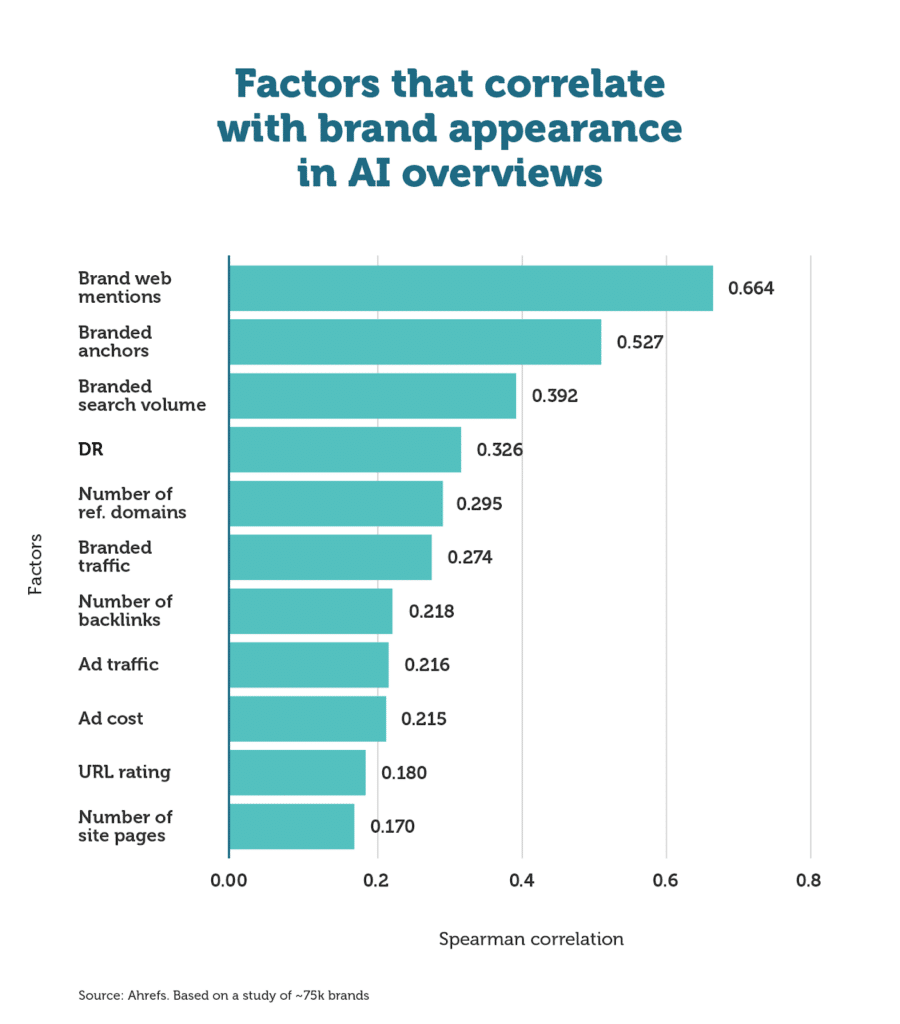
Other AI monitoring tools also launched studies too (like this one from Profound), on the most cited/trusted sources by LLMs - highlighting the need to appear in these top publications to increase chances of being cited.
All of this brought Digital PR back into the spotlight. But not just for links anymore, for brand mentions too. Finally they were being given the attention they deserved.
We’re yet to see what 2026 brings from pop culture to microtrends, but one thing that’s certain - digital PR is fundamental to a strong SEO and GEO strategy, to help drive visibility and ultimately business performance.
We’re still seeing many of the same core tactics being used effectively, but now with brand relevance really being at the heart, robust data, unique insight and speed being key;
- The content campaigns that deliver the best results are more complex, with a strong focus on robust, legitimate data sets and methodologies. We need to be creating something that’s helpful or inspiring for the target audience, that journalists couldn’t create on their own.
- Newsjacking is a huge focus with taking an “always on” approach, and landing quick wins - you need to be quick to react though as the news moves fast. Having an internal expert who can help provide unique commentary that adds something to the story is crucial here, and you need to be able to prove they’re real. AI produced experts and quotes aren’t going to provide value, and will be spotted - these are more likely to be detrimental for the brand with some studies even calling them out.
- Planned reactive - getting quotes or data-led stories ready ahead of time - is also a great way to build topical authority and visibility of an expert.
- Interesting brand news/launches can also be an effective way to land relevant, quality coverage - capitalising on something that’s already going on. As long as it is genuinely newsworthy.
- Stunts are becoming less of a focus in the digital PR industry - with relevancy being essential, many of the stunt styles of the past might not drive the same ROI. Equally, budgets are still being more restricted, so digital PRs are less likely to take risks, and opt for tactics which have a greater chance of driving success.
Wrapping it up: why digital PR matters
2016 saw the dawn of digital PR as we know it today, evolving from a combination of traditional PR and SEO link building. But it’s been on a transformative journey over the past decade. Comparing 2016 vs 2026 shows just how far it has come.
From the initial focus on volume of links to support visibility in traditional search spaces, to relevancy of stories being at the core of driving the right types of links. To now in 2026, branded web mentions also having a fundamental role in GEO, supporting visibility in AI search spaces. It’s clear to see that digital PR has continued to evolve to play a key role in driving online performance over the years, including the tactics and how they’re implemented to gain traction with the media.
References:
- Search Engine Journal (2021) - 20+ years of SEO history
- Google Search Central via YouTube (2021) - Google SEO office-hours from February 19, 2021
- Backlinko (2025) - ChatGPT / OpenAI Statistics
- Ahrefs (2025) - AI Overview brand visibility factors study
- Profound (2025) - AI Platform Citation Patterns
Digital PR in brief
- Digital PR is an SEO-focused strategy that earns brand mentions and links from authoritative publications and websites where your audience already spends time.
- It sits under SEO and supports both search rankings and visibility in generative AI, such as Google’s AI Overviews, ChatGPT and Gemini.
- Brand mentions correlate with AI Overview visibility more strongly than links (Ahrefs, 2025), so earning quality mentions is a primary lever.
- It differs from link building (strategic and relevance-led, not volume-led) and from traditional PR (online-first and measurable).
- Common tactics include digital PR campaigns, thought leadership, reactive PR, refreshing existing content, brand news and PR stunts. Measure it on coverage quality, relevance and new referring domains.
Table of Contents
What is digital PR?
Digital PR (digital public relations), or sometimes known as online PR, is a marketing strategy designed to earn brand coverage and links in the right places; where your target audience sits online, i.e. key authoritative publications and websites in your niche. With consistency, over time this serves to boost brand awareness, and improve topical authority and online visibility - supporting SEO.
It therefore sits under the umbrella of SEO. This includes AEO, GEO and any other terminology you wish to use for the digital search space. It's all essentially the same thing, where people go to search for answers to problems (or their ‘wants’ or ‘desires’).
Digital PR layers on top of a strong technical foundation, and strategic content strategy, to help build and grow online brands and ultimately, drive increased revenue.
optimisation
technical optimisation
Factors that influence the ranking of a web page that are not controlled by the coding or content of the website.
The generation of rich, engaging content on a regular basis that can influence both on-page and off-page optimisation.
The production of content and code on a web page that positively influences search engine ranking.
The search space has evolved over the past few years (hello AIOs, ChatGPT, Gemini and all your favourite LLMs), and with it, digital PR has become even more important. It’s an exciting time for digital PRs as brand mentions have been highlighted as just as important as links for boosting brand visibility in digital search spaces. Something we’ve always talked about as being hints for Google are now actively being shouted about as key focuses for the new AI era.
Digital PR and the rise of Generative AI
Generative AI is everywhere and is being used at many different points of the buyer's journey - from initial problem solving through to now pulling tailored shopping options, and even checking local stores for stock levels - making it important to businesses to appear within the results there too.
To showcase the current scale of generative AI:
- OpenAI CEO Sam Altman announced in October 2025 that ChatGPT had reached 800m weekly active users globally, a 60% increase in just over six months.
- Ahrefs’ 2024 study of AI Overview triggers, which looked at 146 million SERPs, found that Google’s AI overviews currently appear for approximately 20% of searches - with some categories having as high as a 60% chance of triggering an AI overview.
Since the launch of Google’s AI overviews and the increase in use of LLMS (such as ChatGPT, Claude, Gemini and many more) there have been several studies and articles on the factors which correlate with brands being mentioned or brand content being pulled into AI responses.
Ahrefs’ 2025 analysis of AI Overview brand visibility factors, which looked at 75,000 brands, revealed that ‘branded web mentions’ has the strongest correlation with AI overview brand visibility.
It found that:
- Branded web mentions showed the strongest correlation with AI Overview visibility (Spearman: 0.664)
- This was significantly higher than backlinks and nine other tested factors, including DR and branded search volume.
This shows correlation, not causation, but the strength of the pattern indicates that earning high-quality brand mentions should now be treated as a primary lever for AI visibility.
Factors that correlate with brand appearance in AI Overviews
Spearman correlation: the higher the score, the stronger the link to AI Overview brand visibility.
| Brand web mentions | 0.664 |
|---|---|
| Branded anchors | 0.527 |
| Branded search volume | 0.392 |
| DR | 0.326 |
| Number of ref. domains | 0.295 |
| Branded traffic | 0.274 |
| Number of backlinks | 0.218 |
| Ad traffic | 0.216 |
| Ad cost | 0.215 |
| URL rating | 0.180 |
| Number of site pages | 0.170 |
Source: Ahrefs (2025), based on a study of ~75,000 brands.
This, among other studies, have re-highlighted the importance of digital PR for visibility in generative AI, and not just for links, but for earning brand mentions from key websites and publications to build trust and authority too.
While mentions are getting their time in the spotlight, digital PR shouldn’t however just ignore links all together. We know LLMs conduct searches (“queries”) to pull together a response for a user, therefore ranking on traditional search engines is important too - which is where links still come in. Therefore traditional SEO best practices aren’t going anywhere - we’re just evolving!
Digital PR vs link building
Digital PR is a form of link building, but not like in the early 2000s sense of the word - or like the ‘questionable’ tactics we still see today. Digital PR is strategic, targeted and tailored, using storytelling and content to help build links from relevant, authoritative websites (i.e. the ones you want linking to you to make a difference) over time.
Digital PR doesn’t just focus on building a volume of links, from any website in existence - as it’s been highlighted many times by Google that this doesn't move the needle anymore. Google updates over the years have refined what the crawlers consider ‘authority signals’.
Gary Illyes, analyst at Google, was quoted at a search conference in 2024 stating that they need few links to rank pages.
Alongside this, Google’s internal API documentation which surfaced in the 2024 algorithm leak, suggested that the algorithm now scores inbound links based on quality, relevance, and overall trustworthiness. It also suggested that the algorithm seeks contextual relevance from links, and brand mentions - we should mention those too as the documentation highlighted that unlinked brand mentions contribute to search relevance and trust signals, something we’ve believed to be true for a while. Whilst we can’t take the leaked document as definitive, several factors do align with what we’ve seen in organic search over the years.
This highlights that organic visibility is now driven by a blend of signals (not just links alone) which help Google assess trust and authority. To simplify this, we can break this down into a model that reflects how Google increasingly evaluates a brand.
Off-Site trust signals include:
- High-quality links – Links from relevant, authoritative, trustworthy sources
- High-quality mentions – Unlinked but credible references that reinforce your brand’s identity and topical expertise
- Contextual relevance – Coverage from publications within your target niche, demonstrating that your brand is part of the right conversations online
- Entity consistency – Consistent spelling, naming, and context for your brand across all mentions and citations - further highlighting relevance of the content as well as the publication
- Expert attribution – Quotes, commentary, and insights tied to real individuals supporting E-E-A-T and strengthening your brand entities.
To earn these trust signals consistently, we'd recommend sitting on the left of this scale:
Aligned to Google’s updates and direction: aim to sit toward brand building (the left of the scale).
Building the brand’s topical authority, high focus on relevance
- Greater brand & site relevance
- More relevant coverage (& links)
- More relevant traffic
Increasing link profile, usually a large focus on volume
- Reduced brand & site relevance
- Less relevant links
- Less relevant traffic
By earning both coverage and mentions from authoritative sources, you’re building trust signals for both traditional search and AI-driven visibility.
Digital PR vs traditional PR
There are many similarities between digital PR and traditional PR. After all, digital PR was born from traditional PR, and they’re both about building brand awareness and reputation. But they do differ.
Digital PR focuses predominantly on online channels, or opportunities which eventually influence online coverage, as it’s this coverage that will support SEO and benefit website performance.
The traditional PR focuses of print coverage, events and activations aren’t usually priorities for digital PRs - because of effort vs reward, where the reward is focused on benefitting SEO, and being able to measure that.
So, what online channels does digital PR focus on?
The main focus of digital PR is media outreach to secure brand mentions and links. Digital PR strategies for media outreach should target quality, relevant websites and publications in the brand’s niche. These will be key places that the target audience is sat online, and have the best impact in terms of building trust and authority signals to support SEO.
These could be uncovered from an analysis into which publications are writing about, and linking to, competitors, or from research into the target audience and media landscape.
That said, a brand’s target audience is likely to sit in other places online too, such as forums, social media, on emails, etc. Therefore, wherever possible and relevant, amplifying stories through other channels where the target audience sits should also be a consideration. This can lead to further coverage or have an influence on user behaviour, which further supports SEO.
What are the benefits of digital PR?
Digital PR coverage (earned mentions and links) can have many benefits. At Aira we predominantly focus on the SEO side of those benefits;
- Improve topical authority and brand awareness (in Google’s/Generative AI eyes)
- Supports E-E-A-T signals - used by Google to assess quality content
- Can increase branded search - as users search for you after reading coverage
- Improves search engine rankings
- Increases visibility in generative AI
- When part of a holistic digital marketing strategy, these all lead to increased traffic, and revenue.
At Aira, we’ve seen these benefits of digital PR, when part of a holistic strategy, on clients across a range of industries from finance and ecommerce, to travel and even B2B tech/SaaS.
But there are brand benefits to implementing digital PR which we can’t forget too. Especially as digital PR coverage is designed to reach the target audience;
- Boosts brand awareness
- Increases brand reputation and affiliation - helping consumers feel connected to your brand
- Can increase branded search
These brand benefits can just be harder (or more costly) to measure, and sometimes harder to separate from other ATL activity. And it’s important to remember that without being able to separate it, we can’t claim correlation is causation.
How do I know digital PR is right for me?
No matter your industry, you’ll know that increasing brand awareness and visibility is key. If you own or lead an online business, digital PR, and more broadly SEO, should be considered.
A number of industries, like insurance, money saving, healthcare and travel are incredibly noisy, and move quickly. If you operate in a buzzy, competitive online space, the chances are you will need to implement digital PR to be able to compete with active competitors long term.
Some B2B industries can be quieter, with fewer relevant coverage opportunities - so even competitors aren’t featured in key titles that often. If your brand competes in this type of space, it doesn’t mean you don’t need digital PR, it just means the scale of activity will be very different.
Digital PR tends to work best for businesses that;
- Have a strong, technically sound website as a foundation.
- Are in a position to provide expertise on a subject - this could be through data we help source or commentary (which we can guide), and should always be from a named expert.
- Have some creative freedom - we’ll always stay relevant to the brand and target audience, but if our content campaigns and stories are too branded, it’ll limit earned coverage opportunities due to being seen as advertorial. We need some creative freedom to allow innovation and to be able to create a buzz with the target audience.
- Have limited internal restrictions around outreach - due to the speed of the news agenda and opportunities, we’re a very agile team and work quickly to capitalise on all opportunities. That said, we have worked with a number of businesses with internal red tape and legal approval processes, and helped shape internal processes too! So it can work if your internal team is willing to try something new!
If you’re still unsure, we’re always up for an initial conversation where we can help you decide if Digital PR, or perhaps one of our other services is right for you - just get in touch.
What’s the best strategy and approach for digital PR?
There isn’t a one size fits all approach when it comes to digital PR; it highly depends on the industry, websites you want to target and your target audience.
At Aira we will run an audit of your brand website and competitors, including any challenger brands new on the scene. We will dig into your target audience (using any insights and personas you have too!), and conduct a media and cultural landscape analysis to help determine what’s being spoken about, topic gaps, and what might impact relevant opportunities i.e. seasonal or cultural hooks.
All of this insight should be analysed to pull out the target websites, key topics for storytelling, and the tactics which are most likely to be effective. This shapes a tailored strategy and approach for each brand, which is taken into ideation sessions.
The strongest ideas from our sessions are run through a rigorous concepting process which has been evolved over the years, to ensure only the most robust ideas move ahead to client approval. We’ll manage the production from end-to-end, producing copy and design if required, and following approval, will outreach to target online media to secure coverage. We’ll also work with relevant teams to further amplify the story across owned media.
We’ll always keep the brand up-to-date on outreach and earned media coverage. We’ll regularly review activity and feed any learnings back into the ideas and approach.
Therefore a framework for a typical approach looks like this;
Continually feeding learnings back into the insights fuelling approach and ideas
- Research and auditing - competitors and industry, target audience, media and cultural landscape
- Analysis & Insights - Pulling out the key focuses for tactics, topics and target websites
- Ideation - Ideas which align to the findings
- Production - Storytelling, including the right elements, and ensuring the brand is positioned as an authority
- Outreach - Tailored and targeted
- Reporting and evaluation - feeding learnings back into the strategy
Which digital PR tactic is most effective for 2026?
Just like the strategy, there isn’t one leading tactic for everyone - it depends on the industry and space you’re operating in.
However, there are several tactics we tend to rely on at Aira. And it always works best when you combine these throughout the year, and scale up and down, reacting to the landscape and what’s currently happening.
These are the tactics we tend to use most often, alongside what each tactic is and some of our favourite examples to bring these to life.
| Tactic | What is this tactic? | Some of our team’s favourite examples over the years |
|---|---|---|
| Digital PR campaign | A data or insight-led creative story, which uncovers something new (and relevant) to create headlines for digital PR outreach. These range in scale and complexity, and can be produced with or without content (and design). Large scale campaigns could be interactive or include video. Our internal team of creatives manages everything from end-to-end, designing each campaign with multiple angles for longevity, to help attract coverage and links over time. |
|
| Thought leadership | Using a brand’s internal experts to provide commentary to press on relevant trending topics, which are important to the target audience. This could be ahead of a seasonal hook like Black Friday or key travel periods. Quotes will always be human-written, and can be drafted by the Aira team for brands to add to. We introduce your brand to key press contacts to get them front of mind for any future content too. |
|
| Reactive PR | This isn’t just waiting for opportunities to land in our inbox and hitting reply. We constantly monitor the news and proactively outreach in response to breaking news. We need to be collaborative and quick with this tactic, but this can add great value. And yes, this can be done across time zones too! |
|
| Existing content | We don’t always need to create more content. Sometimes we can give your blog content a little zhuzh using our creative flair, to help create new topical stories for outreach. This could be updating or adding new data or quotes, and even including new design assets if valuable. |
|
| Brand news | We look to capitalise on all relevant coverage opportunities, so if a brand has a new product launch or some business news which we believe more of the world should know about, we might be able to help here too. We just need to be kept in the loop with any upcoming news and we can do the rest. |
|
| PR stunt | A one-off time-sensitive, attention-grabbing innovative story. This could be creating something (physically or digitally) different to normal to create a buzz and get people talking. |
|
How do you measure digital PR? What are digital PR KPIs?
PR measurement has always been a challenge. Looking back over the years, traditional PR metrics have often been criticised, from claims of having billions of eyeballs on a story/brand message, to different calculations for an equivalent cost in advertising value.
It’s always crucial to stay as close to tangible outputs as possible, especially when looking at lead digital PR metrics and KPIs - i.e. results we know we impacted/can impact.
For digital PR this should always be direct outputs, which are, coverage (brand mentions or links), including the quality (domain authority/rating) and relevancy scores, as well as reporting on new referring domains. Relevancy scores could also include territory/country of coverage.
By sitting under the umbrella of SEO, Digital PR has a slightly easier job with reporting on longer term benefits. But it can still be an obstacle we need to tailor an approach to, and overcome together with the brand - to also ensure we’re delivering reporting that the brand needs internally.
Metrics which could be reported on as longer term measures of digital PR success include;
- Search rankings and share of voice
- Brand search volumes and clicks
- Other traffic, such as referral and direct - as noreferrer link clicks can show here. You can also create a custom group channel to show traffic from AI sources.
- Mentions or share of voice in generative AI
- Conversions/leads
- Revenue
It’s key to note, when looking at longer term reporting for digital PR and wider benefits, a lot of the time we’re discussing correlations and not causation. These should only be included if it can be confidently discussed that there’s a correlation, and there was no other big marketing activity which could have impacted this.
How much does digital PR cost?
Packages are tailored, and therefore costs, based on your budget and/or recommended on what you need to compete in your industry space. Some brands/industries will need less activity and therefore less budget, whereas others are highly competitive, so there is no specific cost that works for all.
At Aira, we generally work best with clients who can invest at least £3,000 a month. That said, the more you have to work with, the faster we can move, and the more we can tackle for you to help move the needle.
When we start discussing a proposal, we can suggest a couple of cost options so you can see the difference in scale.
If you don’t quite have that much, we might still be able to help or point you in the right direction, so do still get in touch.
To summarise on what digital PR is…
Digital PR is a marketing strategy that sits under SEO. It uses tactics to secure earned brand mentions and links, to grow brand awareness, topical authority and visibility, supporting search engine rankings and visibility in generative AI.
With the rise of generative AI, Digital PR has become even more important as it’s a fundamental way of earning brand mentions (as well as links) in the right places, which correlates with increased visibility in these new search spaces.
Digital PR differs to traditional PR and link building, with its focus on benefitting more areas which support online performance in today’s evolved search space.
It’s important to note that there isn’t a one size fits all approach when it comes to digital PR, or one tactic that would work for every brand; it highly depends on the industry, websites you want to target and your target audience. All digital PR strategies and approaches should therefore be tailored, and utilise a number of tactics across the year to maximise coverage opportunities.
Measuring digital PR, and the wider benefits specifically, can be challenging. We recommend sticking to tangible outputs, like coverage, quality and relevancy, as lead metrics and KPIs. Then, working together on an agreed approach to reporting on wider benefits.
If you still have questions or would like further clarity on how digital PR could support your brand, drop us a message and we’d be more than happy to chat.
References:
- Ahrefs (2024) - AI Overview triggers study
- Techcrunch (Oct, 2025) - ‘Sam Altman says ChatGPT has hit 800M weekly active users’
- Ahrefs (2025) - AI Overview brand visibility factors study
- Google API Documentation (2024 leak) - ‘Secrets from the Algorithm: Google Search’s Internal Engineering Documentation Has Leaked’
- Search Engine Journal (April, 2024) - ‘Google Confirms Links Are Not That Important’